ICF
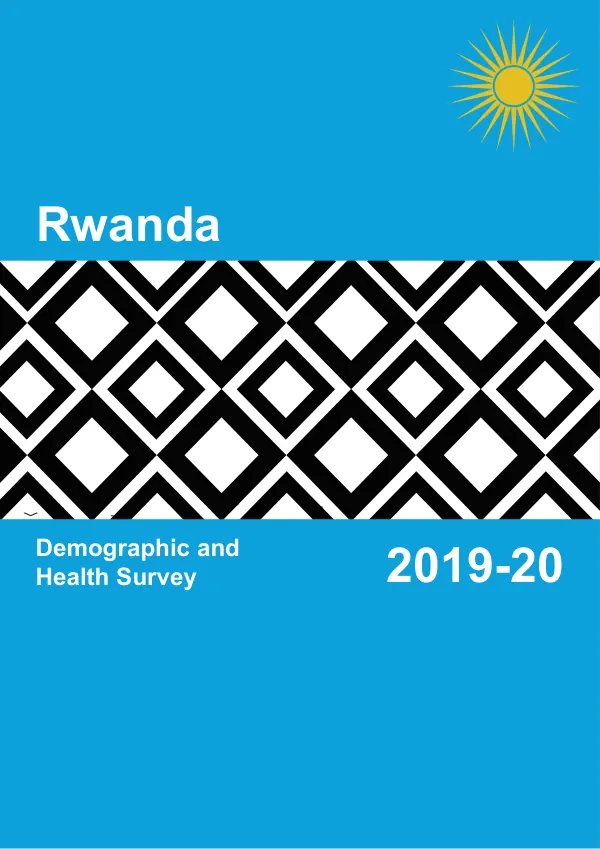
Rwanda Demographic and Health Survey 2019-20 Final Report
The 2019-20 Rwanda Demographic and Health Survey (2019-20 RDHS) was implemented by the National Institute of Statistics of Rwanda (NISR) in collaboration with the Ministry of Health (MOH).
2021 · 619 pages
Sign in to readA free account is required to download.
Abstract
The funding for the 2019-20 RDHS was provided by the Government of Rwanda, United States Agency for International Development (USAID), the United Nations Children’s Fund (UNICEF), the United Nations Population Fund (UNFPA), Enabel (Belgian Development Agency), UNWOMEN, and the Centers for Disease Control and Prevention (CDC). ICF provided technical assistance through The DHS Program, a USAID-funded project that provides support and technical assistance in the implementation of population and health surveys in countries worldwide. The survey aimed to provide data on key indicators for the Sustainable Development Goals (SDGs) and to assess the progress of Rwanda towards achieving the SDGs. The survey collected data on a wide range of topics, including demographic characteristics, housing characteristics, household population, education, employment, health insurance coverage, marital status, marital status, fertility, fertility preferences, and more. The survey used a two-stage sampling design, with the first stage involving the selection of clusters and the second stage involving the selection of households within the clusters. The survey collected data from 12,000 households and 12,000 women aged 15-49 years. The survey also collected data on anthropometry, anemia, malaria, HIV, and micronutrient testing. The survey found that the majority of households in Rwanda (95%) had access to improved drinking water sources, while 83% of households had access to improved sanitation facilities. The survey also found that 71% of households had a radio, while 45% had a television. The survey found that 35% of women aged 15-49 years had completed secondary education, while 12% had completed higher education. The survey found that the total fertility rate (TFR) in Rwanda was 4.4 children per woman, while the general fertility rate (GFR) was 143 births per 1,000 women aged 15-49 years. The survey also found that 22% of women aged 15-19 years had given birth, while 12% of women aged 20-24 years had given birth. The survey found that 45% of women aged 15-49 years had used a modern contraceptive method, while 15% had used a traditional contraceptive method. The survey also found that 35% of women aged 15-49 years had an unmet need for family planning, while 20% had an unmet need for modern family planning. The survey found that 45% of women aged 15-49 years had experienced physical violence, while 15% had experienced sexual violence. The survey also found that 35% of women aged 15-49 years had experienced emotional violence, while 20% had experienced economic violence. The survey found that 35% of women aged 15-49 years had experienced intimate partner violence, while 20% had experienced non-partner violence. The survey also found that 25% of women aged 15-49 years had experienced physical violence from a partner, while 15% had experienced sexual violence from a partner. The survey found that 45% of women aged 15-49 years had experienced physical violence from a non-partner, while 20% had experienced sexual violence from a non-partner. The survey also found that 35% of women aged 15-49 years had experienced emotional violence from a non-partner, while 20% had experienced economic violence from a non-partner.
Related documents