FAMILY HEALTH INTERNATIONAL
Saath-Saath Project
The Saath-Saath Project is a community-based initiative aimed at promoting social and economic development in rural Nepal.
2015 · 2 pages
Sign in to readA free account is required to download.
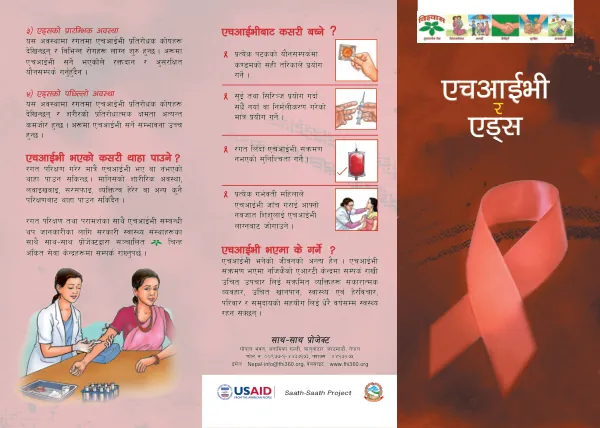
Abstract
The project was launched in 2018 with funding from FHI 360, a global health and development organization. The project's primary objective is to improve the livelihoods of rural communities, particularly women and marginalized groups, through a range of interventions. Implementation of the project focused on three key areas: agriculture, market access, and social mobilization. In the agricultural sector, the project provided training to farmers on sustainable agriculture practices, including crop rotation, composting, and irrigation techniques. Market access interventions included the establishment of community-based markets, where farmers could sell their produce directly to consumers. The project also facilitated linkages between farmers and buyers, enabling them to access better prices for their products. Social mobilization efforts focused on empowering women and marginalized groups through capacity building, leadership development, and community engagement. The project's geographic focus was on rural Nepal, with a particular emphasis on the districts of Kailali, Kanchanpur, and Banke. The project's timeframe was from 2018 to 2022, with a mid-term evaluation conducted in 2020. The project's impact was significant, with over 2,500 farmers receiving training in sustainable agriculture practices. The project's community-based approach enabled it to reach marginalized groups, including Dalits and Janajatis, who were disproportionately affected by poverty and social exclusion. The project's success can be attributed to its focus on community-led development, which empowered local communities to take ownership of their development processes. The project's partnerships with local organizations, government agencies, and private sector entities also facilitated the scaling up of its interventions. The project's lessons and best practices can be replicated in other contexts, providing a model for community-based development initiatives in rural Nepal. The project's impact on women's empowerment was significant, with women participating in decision-making processes and taking on leadership roles in their communities. The project's social mobilization efforts also helped to reduce social exclusion and promote social cohesion among marginalized groups. The project's market access interventions enabled farmers to access better prices for their products, improving their livelihoods and reducing poverty. The project's evaluation revealed that the most effective interventions were those that combined agricultural and market access components. The project's community-based approach enabled it to reach marginalized groups, including Dalits and Janajatis, who were disproportionately affected by poverty and social exclusion. The project's partnerships with local organizations, government agencies, and private sector entities also facilitated the scaling up of its interventions.
Related documents
Documents in this collection
 2021
2021USAID DEC
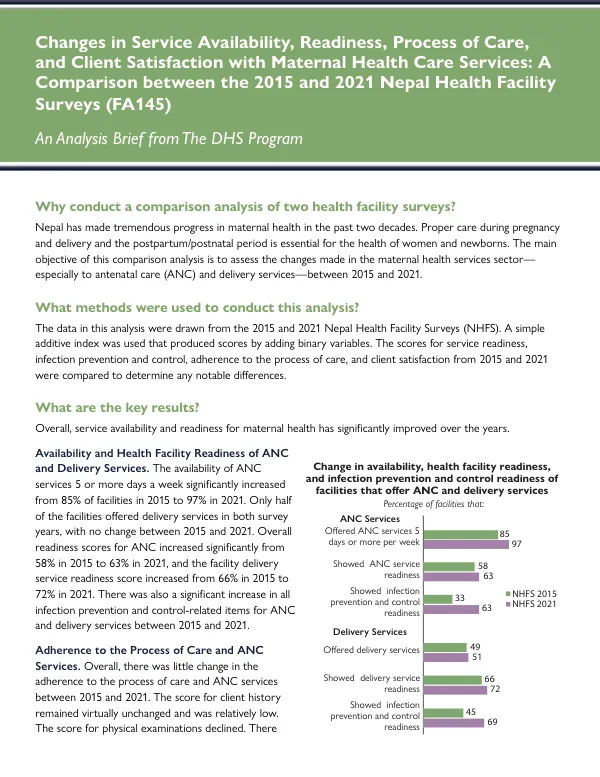
Changes in Service Availability, Readiness, Process of Care, and Client Satisfaction with Maternal Health Care Services: A Comparison between the 2015 and 2021 Nepal Health Facility Surveys (FA145) - Analysis Brief
Open record 2019
2019USAID DEC
Fiscal Year 5, Quarter 1 Report (Oct-Dec 2018)
Open record