POWER AFRICA
SAEP Quality of Supply Workshop Day 1
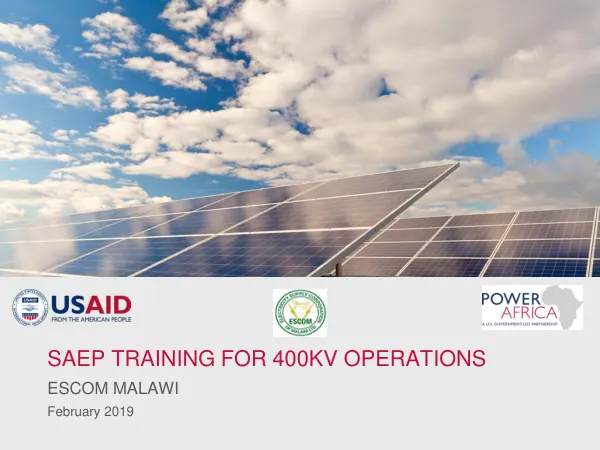
SAEP TRAINING FOR 400KV OPERATIONS ESCOM MALAWI February 2018 The USAID Southern Africa Energy Program's main objective is to develop generation, transmission, and distribution infrastructure, while promoting investment in the energy sector for a brighter, more sustainable future.
2019 · 11 pages
Sign in to readA free account is required to download.
Abstract
The program targets 11 countries in Southern Africa, including Angola, Botswana, Lesotho, Madagascar, Malawi, Mozambique, Mozambique, Namibia, South Africa, Swaziland, and Zimbabwe. The program is funded by the United States Agency for International Development (USAID), in support of the US Government's Power Africa initiative. Power Africa has committed over $52 billion to mobilize and organize international efforts to electrify Africa. USAID supports Power Africa through programs that bring together technical and legal experts, the private sector, and governments from around the world to work in partnership to increase access to power. The regional partnership focuses on strengthening the regional enabling environment and facilitating transactions. The program aims to increase investment in electricity supply and access by improving regulation, procurement, and procurement processes, as well as facilitating transactions. The program has five key outcomes: improved regulation, improved financial viability of utilities, improved regional harmonization and cross-border trade, scaled renewable energy and energy efficiency, and improved human and institutional capacity. A 5-day workshop was facilitated by Mr. Johannes Uys, SAEP's Short-Term Technical Advisor, to provide training on 400kV operations for ESCOM Malawi. The workshop covered fundamental principles of regulations, access to high voltage areas, and operating instructions. The practical evaluation of ESCOM's O&M staff on high voltage operating was conducted at Blantyre West substation. The workshop also included a review of the Safety Rule Book and Operating Regulations for High Voltage Systems (ORHVS). The program aimed to prepare ESCOM personnel for operating and maintaining a 400kV transnational system, as well as preparing them for operating in an interconnected system. The advisor, Mr. Johannes Uys, engaged ESCOM to develop a 400kV operations training program, focusing on the transnational component of the activity. A separate advisor will focus on the transnational component, covering voltage control, voltage control, and managing load to ensure stability. The program also included a gap analysis of the Safety Rule Book and ORHVS, identifying areas where the ORHVS could be used to improve ESCOM's operations as they started to operate at 400kV. The ORHVS is a regulatory mandate in South Africa, providing clear instructions on how to safely operate on a high voltage power system. ESCOM has a Safety Rule Book, which aims to practically safeguard persons and equipment during installation, operation, and maintenance of electrical power systems and associated equipment. The workshop covered the following modules: Fundamental principles of regulations, access to high voltage areas, keys, sequence of operating, safety testing, and earthing, operating instructions, commissioning, and working in close proximity to live conductors. The practical evaluation of ESCOM's O&M staff on high voltage operating was conducted at Blantyre West substation. The necessary arrangements were made for Transformer 2 66/33kV to be opened, isolated, and earthed to conduct this evaluation. The program aimed to improve ESCOM's operations and maintenance capabilities, enabling them to operate and maintain a 400kV transnational system. The program also aimed to improve ESCOM's capacity to operate in an interconnected system, ensuring stability and manage load. The program's outcomes include improved regulation, improved financial viability of utilities, improved regional harmonization and cross-border trade, scaled renewable energy and energy efficiency, and improved human and institutional capacity.
Related documents