USAID DEC
SARS-CoV-2 Surveillance in the Middle East and North Africa: Longitudinal Trend Analysis
Sign inFLORIDA INTERNATIONAL UNIVERSITY
SARS-CoV-2 Surveillance in the Middle East and North Africa: Longitudinal Trend Analysis
The COVID-19 pandemic has had a significant impact on the Middle East and North Africa (MENA) region, with widespread transmission and varying levels of health system preparedness.
2021 · 11 pages
Sign in to readA free account is required to download.
Abstract
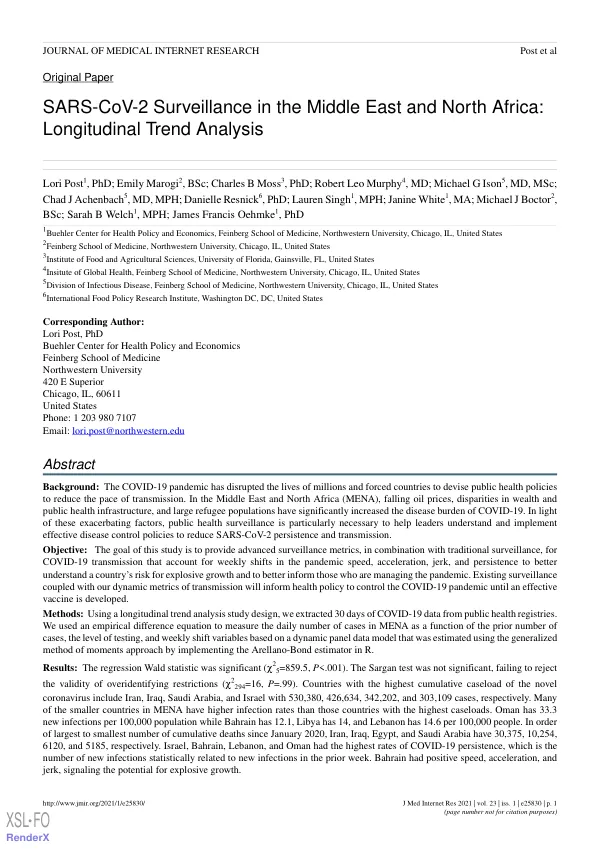
The region is characterized by large wealth disparities and regional conflicts, increasing the risks to the pandemic. Despite early implementation of strict containment measures, the spread of SARS-CoV-2 has continued, with 2,982,597 confirmed cases and 75,737 deaths reported in the region as of October 28. Countries in MENA have employed a combination of containment and mitigation strategies, including isolation of cases, contact tracing, social distancing, border closures, masking, hand and surface hygiene, and travel restrictions. However, the absence of a vaccine necessitates the use of systemic public health surveillance to track cases and identify where outbreaks will occur. Global SARS-CoV-2 surveillance requires dividing the globe into separately surveyed regions, with the MENA region comprising 22 countries. The MENA region has a complex economic landscape, with a dual crisis resulting from the COVID-19 pandemic and the collapse of oil prices. This has been exacerbated by structural economic challenges, including large and inefficient public sectors, uncompetitive business environments, high youth and female unemployment, governance challenges, and regional conflicts. The World Bank has recommended a coordinated regional MENA trade integration framework to lay the foundation for global value chain integration and improve economic prospects. The COVID-19 pandemic has also highlighted the importance of health infrastructure in the MENA region. Violent conflicts have weakened the health infrastructure in several countries, resulting in poor health worker capacity. However, outside of conflict regions, MENA countries have some of the lowest proportion of health workers, which has been exacerbated by the pandemic. The region's health systems have been stretched to the limit, with many countries struggling to provide adequate care to those affected by the pandemic. The study analyzed 30 days of COVID-19 data from public health registries in the MENA region, using a longitudinal trend analysis study design. The data was extracted using an empirical difference equation to measure the daily number of cases as a function of the prior number of cases, the level of testing, and weekly shift variables. The regression Wald statistic was significant, indicating that the model was a good fit for the data. The Sargan test was not significant, failing to reject the validity of overidentifying restrictions. The study found that countries with the highest cumulative caseload of the novel coronavirus include Iran, Iraq, Saudi Arabia, and Israel, with 530,380, 426,634, 342,202, and 303,109 cases, respectively. Many of the smaller countries in MENA have higher infection rates than those countries with the highest caseloads. Oman has 33.3 new infections per 100,000 population, while Bahrain has 12.1, Libya has 14, and Lebanon has 14.6 per 100,000 people. In order of largest to smallest number of cumulative deaths since January 2020, Iran, Iraq, Egypt, and Saudi Arabia have 30,375, 10,254, 6120, and 5185, respectively. The study also found that Israel, Bahrain, Lebanon, and Oman had the highest rates of COVID-19 persistence, which is the number of new infections statistically related to new infections in the prior week. Bahrain had positive speed, acceleration, and jerk, signaling the potential for explosive growth. The study concluded that static and dynamic public health surveillance metrics provide a more complete picture of pandemic progression across countries in MENA. Static measures capture data at a given point in time, such as infection rates and death rates, while dynamic metrics account for weekly shifts in the pandemic speed, acceleration, jerk, and persistence.
Related documents