HEALTH POLICY PLUS
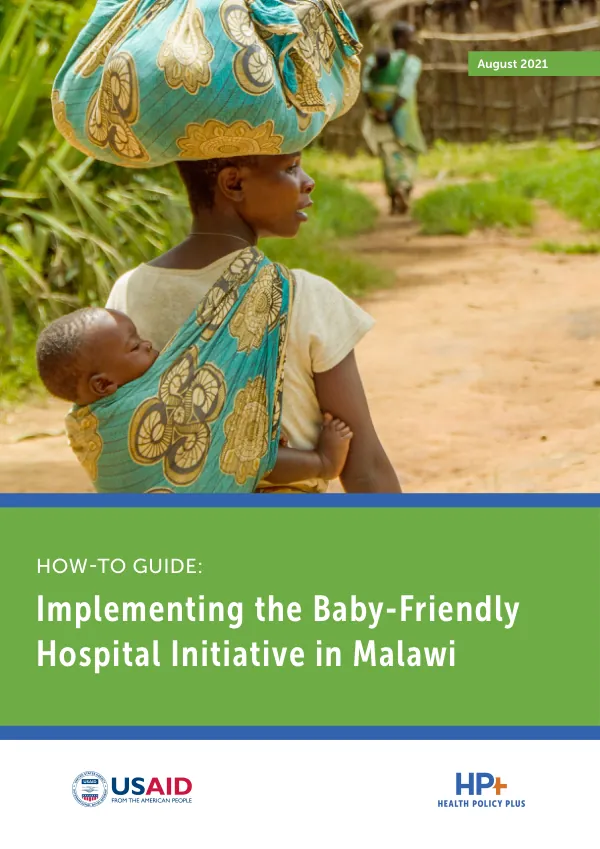
Scale-Up of the Baby-Friendly Hospital Initiative in Malawi
The Baby-Friendly Hospital Initiative (BFHI) is a global effort to promote exclusive breastfeeding for the first six months of life.
2021 · 8 pages
Sign in to readA free account is required to download.
Abstract
In Malawi, the BFHI program was initially implemented from 1993 to 2007, with a slow increase in exclusive breastfeeding rates from 2.1 percent in 1992 to 71 percent in 2010. However, the rate declined to 61 percent in 2015 due to various challenges, including a lack of health facility promotion of exclusive breastfeeding, high facility staff turnover, inadequate monitoring, and low morale among health workers. The BFHI program in Malawi was revitalized in 2016 by the U.S. Agency for International Development's (USAID) Maternal and Child Survival Program (MCSP). MCSP assisted the Ministry of Health in revising the manual for the 20-hour BFHI course and updating the BFHI package tailored for Malawi, which aligned with World Health Organization (WHO) 2009 guidelines. The updated package was implemented in 15 district hospitals and three health centers, reaching 18 facilities. From 2016 to 2018, MCSP trained approximately 1,300 clinical and 600 support staff across Malawi in the BFHI. However, the initial rollout of the program had shortcomings, including a lack of coaching, mentoring, or supportive supervision, which made it difficult for facilities to relate written feedback to their practice. As a result, most facilities failed to improve their performance and did not qualify for baby-friendly accreditation. Despite the initial challenges, the BFHI program continued to scale up to other districts, with the same approach being used. However, only three facilities passed the assessment and received accreditation during MCSP's implementation, and an additional three facilities passed but had not yet received accreditation by the time MCSP implementation ended. In 2018, USAID requested that the Health Policy Plus (HP+) project provide technical support to the Ministry of Health to strengthen follow-on work of the BFHI program. The HP+ project adapted the BFHI implementation by instituting ongoing training for healthcare providers and training community members to support breastfeeding mothers. The project also enlisted community volunteers, such as mother-to-mother support groups and community promoters, to provide peer support in the communities where HP+ was implementing. The HP+ project made several key adaptations to the implementation, training, and coaching, including providing onsite mentoring with immediate, observable feedback. This approach helped staff make adjustments in partnership with the mentors and agree on measures to address identified gaps. The project also established a community referral system at the outset, recognizing the critical importance of supportive communities in promoting exclusive breastfeeding. The BFHI program in Malawi has shown promising results, with a significant increase in exclusive breastfeeding rates among infants. According to the National Statistical Office (NSO) and ICF, at 0-1 month of age, 80 percent of infants were exclusively breastfed, compared with 69 percent of infants 2-3 months of age, and only 34 percent of infants 4-5 months of age. The BFHI program continues to be an essential strategy for promoting maternal and child health in Malawi, and its implementation is crucial for achieving the country's health goals.