AVENIR HEALTH
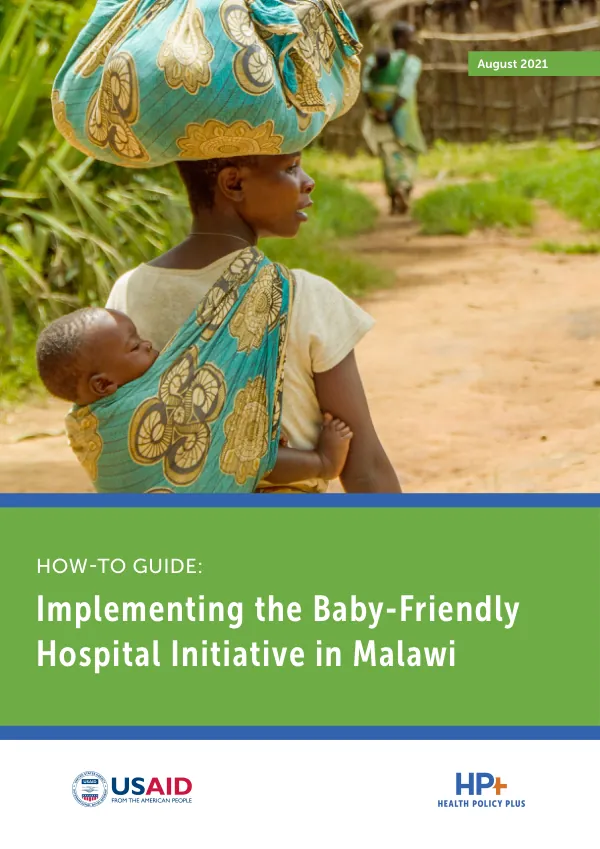
How-to Guide: Implementing the Baby-Friendly Hospital Initiative in Malawi
The Baby-Friendly Hospital Initiative (BFHI) in Malawi began in 1993, shortly after the global initiative was launched by UNICEF and the World Health Organization (WHO) in 1991-1992.
2021 · 38 pages
Sign in to readA free account is required to download.
Abstract
The introduction of BFHI in Malawi led to improved breastfeeding outcomes, with the proportion of infants under six months exclusively breastfed increasing from 2.1 percent in 1992 to 71 percent in 2010. This improvement was attributed to the enhanced skills of healthcare providers in counseling and supporting breastfeeding. The Malawi Ministry of Health (MOH) remains committed to nationwide BFHI scale-up through public and private sectors, nongovernmental organizations, and other implementing partners. The goal is to devolve responsibilities to partners at subnational levels, facilities, and hospitals. To achieve this, the MOH has revitalized efforts to implement BFHI, with support from the U.S. Agency for International Development's (USAID's) Maternal and Child Survival Program (MCSP) from 2016 to 2018 and subsequently from USAID's Health Policy Plus (HP+) project. The BFHI is a comprehensive approach to breastfeeding promotion and support in hospitals and healthcare facilities. It involves ten steps, including having a written breastfeeding policy, informing all pregnant women about the benefits and management of breastfeeding, and helping mothers initiate breastfeeding within the first hour after birth. The initiative also emphasizes the importance of rooming-in, feeding on demand, and providing support for breastfeeding mothers. The guide aims to equip program implementers, managers, supervisors, providers, and other stakeholders with the necessary technical and operational resources to train and support a large number of providers in their respective areas and facilities. It provides evidence-based approaches and learnings to assist program implementers, facility and/or hospital managers, supervisors, government institutions, and partners to scale up or integrate the BFHI in their programs and/or facilities. The guide includes HP+ experiences and learnings from BFHI implementation in 12 hospitals as of May 2020. It complements the MOH's BFHI 20-hour course, "Breastfeeding Promotion and Support in a Baby-Friendly Hospital," and provides programmatic guidance on how to effectively scale up BFHI implementation throughout Malawi. The guide comprises the following sections: Background, Implementation, Assessments, Supportive Supervision, and Mentoring, Annex A: 2018 Implementation Guidance on the Ten Steps to Successful Breastfeeding, Annex B: Monitoring and Evaluation, Annex C: Sample Budget and Logistics, Annex D: Timetable for Training of Clinical Staff, and Annex E: BFHI Certificate and Shield. The BFHI has undergone changes over time, with the most recent updates incorporated into the guide. The guide provides a comprehensive approach to BFHI implementation, including critical aspects and approaches that need to be considered. It also emphasizes the importance of assessments, supportive supervision, and mentoring in ensuring the successful implementation of BFHI. The guide is intended to provide programmatic guidance on how to effectively scale up BFHI implementation throughout Malawi.