MINISTRY OF HEALTH
Kangaroo Mother Care in Rwanda
The Ministry of Health in Rwanda has committed to improving the health outcomes of preterm and low-birthweight (LBW) babies by leading the scale-up of facility-based kangaroo mother care (KMC) services since 2007.
2018 · 5 pages
Sign in to readA free account is required to download.
Abstract
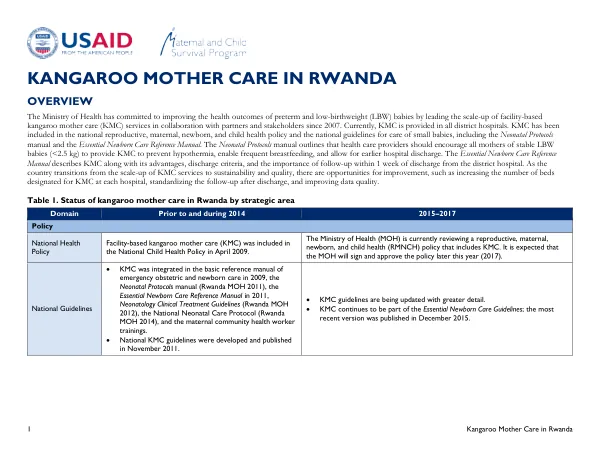
KMC is provided in all district hospitals and has been included in the national reproductive, maternal, newborn, and child health policy and the national guidelines for care of small babies. The Neonatal Protocols manual outlines that health care providers should encourage all mothers of stable LBW babies to provide KMC to prevent hypothermia, enable frequent breastfeeding, and allow for earlier hospital discharge. Implementation of KMC services has been scaled up to all district hospitals, with an estimated 75% or more of LBW newborns initiated on facility-based KMC. The national health insurance scheme, Mutuelle Santé, includes KMC in its coverage, and funding mostly comes from the Ministry of Health. Research studies have been conducted on KMC follow-up after discharge, and knowledge management centers of excellence have been established for KMC and care of LBW babies. However, challenges remain, including major funding gaps for KMC, a need for more beds and space for KMC at hospitals, lack of food at hospitals for new mothers, and lack of nutritional support for LBW babies. Additionally, it is not always possible for mothers to bring the babies back to the health facilities for checkups due to long distances and lack of access to transportation. Lessons learned from the scale-up of KMC in Rwanda include the importance of strong leadership from the Ministry of Health and support from partners and other stakeholders. KMC has been integrated into national policies and guidelines, as well as into the health management information system and registers. Future actions include reviewing neonatal protocols against best practices to promote early and exclusive breastfeeding using minimum enteral nutrition approaches, offering mentorship on these approaches, and developing guidelines for follow-up with preterm/LBW babies after discharge. The Ministry of Health has also established partnerships with professional organizations, such as the Rwanda Paediatrics Association and the Rwanda Association of Midwives, to promote KMC through training and mentorships in health facilities. Strong local KMC champions have been identified, including Dr. Agnes Binagwaho, former minister of health, and Dr. Mwali (Assumpta) Kayinamura. The Ministry of Health continues to be a strong champion for KMC, with a commitment to continuous engagement and quality improvement activities focused on family-centered care. Demographic and Health Survey (DHS) proxy indicators for KMC in Rwanda show that 92.2% of births have a reported birthweight, and 6.3% of babies weighing less than 2.5 kg among births with a reported birthweight. Initial breastfeeding rates are high, with 80.5% of children born in the past 2 years starting breastfeeding within 1 hour of birth and 95.7% starting breastfeeding within 1 day of birth. However, skin-to-skin contact rates are not available. The Ministry of Health has also established a system for monitoring and evaluation of KMC services, with indicators included in the national health management information system (HMIS). However, there are opportunities for improvement of data quality and completeness.
Related documents