USAID DEC
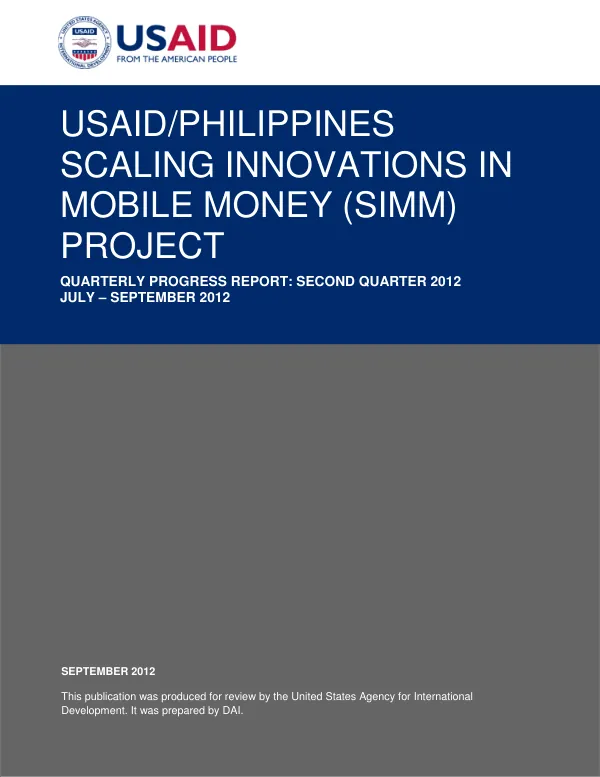
Scaling Innovations in Mobile Money (SIMM) Project Quarterly Progress Report: First Quarter 2012
Sign inDAI
Scaling Innovations in Mobile Money (SIMM) Project Quarterly Progress Report: First Quarter 2012
The Scaling Innovations in Mobile Money (SIMM) project aims to expand financial services in the Philippines by leveraging existing electronic money channels.
2012 · 16 pages
Sign in to readA free account is required to download.
Abstract
The project builds upon USAID interventions in microenterprise access and mobile banking to further increase financial inclusion for broad-based economic growth. SIMM targets three broad areas of strategic intervention: the payment system, government services, and electronic payroll distribution. To achieve these goals, SIMM will address supply and demand constraints to broader adoption of m-money in the Philippines and promote global knowledge sharing. The project will work with the government, mobile network operators, financial institutions, and local organizations to address obstacles impeding the growth of branchless banking. SIMM focuses on three primary areas: creating business models that scale, achieving inclusive user uptake, and promoting global knowledge sharing of m-money. Key activities for the first quarter of the project (April 26, 2012 to June 30, 2012) centered on the operational and technical activities indicated in the project start-up plan. These tasks entailed mobilization of both in-country and home office resources to ensure a smooth and efficient project launch. The project leveraged USAID's and DAI's existing networks to secure initial meetings with key stakeholders from the government, private sector, and USAID donor community. The project office was set up, and the start-up plan, life of project, and Year 1 workplan were developed. Initial partnership collaboration activities were initiated with stakeholders from the government, private sector, and USAID donor community. Progress was made on the project's knowledge sharing and monitoring and evaluation activities. The SIMM project aims to deliver several results, including the growth of m-money to more than 1.3 million active users, training of more than 12,500 people in financial education and literacy, and the opening of more than 10,000 savings accounts via m-banking. The project also aims to increase e-payroll implementation and adoption, increase the volume of m-money transactions, and promote global knowledge sharing. Regulatory constraints may affect how workplan strategies and activities will be carried out in the ensuing quarters. The project will need to address these challenges and opportunities to ensure the successful implementation of its activities. The key activities and expected results for next quarter's implementation will focus on building on the progress made in the first quarter and addressing the emerging challenges and opportunities. The SIMM project will work with key stakeholders to address the regulatory constraints and ensure the successful implementation of its activities. The project will also continue to promote global knowledge sharing and monitoring and evaluation activities to ensure that its goals and objectives are met. The project's progress will be closely monitored, and adjustments will be made as necessary to ensure the successful implementation of its activities. The SIMM project's success will depend on its ability to address the regulatory constraints and ensure the successful implementation of its activities. The project will need to work closely with key stakeholders to address these challenges and opportunities and ensure that its goals and objectives are met. The project's progress will be closely monitored, and adjustments will be made as necessary to ensure the successful implementation of its activities. The SIMM project's focus on creating business models that scale, achieving inclusive user uptake, and promoting global knowledge sharing of m-money will be critical to its success. The project's ability to address the regulatory constraints and ensure the successful implementation of its activities will be essential to achieving its goals and objectives. The project's progress will be closely monitored, and adjustments will be made as necessary to ensure the successful implementation of its activities.