POPULATION COUNCIL
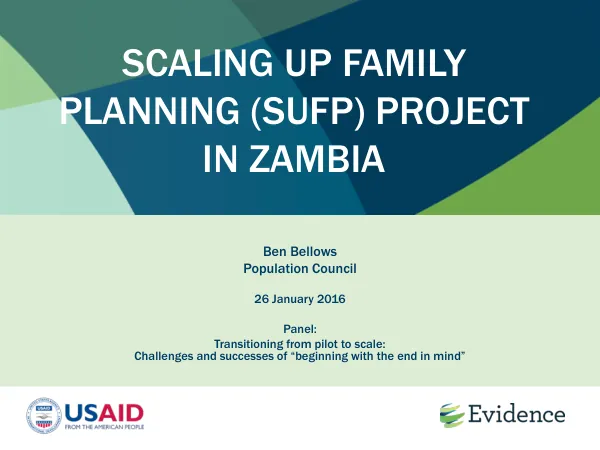
Scaling Up Family Planning (SUFP) Project in Zambia
The Scaling Up Family Planning (SUFP) project in Zambia aimed to increase the uptake of family planning services among underserved populations through the public sector.
2016 · 18 pages
Sign in to readA free account is required to download.
Abstract
The 4-year program, initiated in 2018, focused on recruiting district-level family planning coordinators, conducting extensive demand generation at the community level, and boosting provider capacity through training. The project also employed an intensive camping approach to jumpstart outreach efforts and ensured a reliable supply chain. The SUFP strategy targeted 20 districts in Zambia, with a focus on improving the provision of family planning services. The program's implementation involved the recruitment of district-level family planning coordinators, who worked closely with community volunteers and government workers to deliver services. The camping approach, which involved setting up temporary health facilities in rural areas, was used to reach underserved populations and provide access to family planning services. The SUFP project made significant progress in its first three years, with 7 districts reached in year 1, 13 districts added in year 2, and 6 districts added in year 3, bringing the total to 26 districts. The program's efforts led to an increase in the number of women of reproductive age accessing family planning services, with a target growth of 0% achieved in all districts. The number of children and young people (CYPs) provided with support from SUFP also increased, from 34,285 in 2014 to 44,313 in 2016. A costing assessment of the SUFP project was conducted in 2015 to guide the Ministry of Health and partners on the cost of the SUFP approach. The assessment used USAID's iCCM cost modeling and financing tool, which is an activity-based dynamic tool designed for analysis of cost-effectiveness and what-if scenarios. The results of the costing assessment showed that the average start-up, replacement, and recurrent cost per CYP was $20.69 in 2015, with a projected recurrent cost per CYP of $18.37 in 2016. The SUFP project also made significant contributions to the global learning on scale up of family planning programs. An external assessment of the project was conducted in 2015, which provided recommendations regarding the feasibility of integrating the SUFP strategies, including the camping approach, into Zambia's public sector family planning system. The assessment also explored the fidelity and adaptation of SUFP strategies during the scale-up process and identified barriers and facilitators to scale up of the SUFP strategies. The SUFP project's success was attributed to its focus on strengthening existing systems to scale, including the use of existing structures and community volunteers. The program's health system strengthening aspect was also considered crucial in achieving its goals. The project's impact was evident in the increased awareness of family planning services among community members and the improved provision of family planning services in the targeted districts.
Related documents