USAID DEC
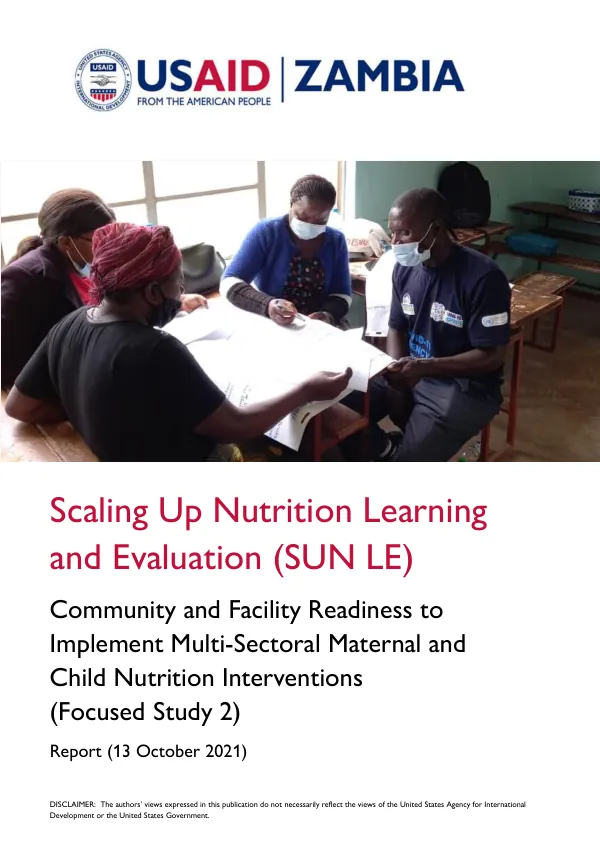
Scaling Up Nutrition Learning and Evaluation (SUN LE) Community and Facility Readiness to Implement Multi-Sectoral Maternal and Child Nutrition Interventions (Focused Study 2)
Sign inMINISTRY OF AGRICULTURE
Scaling Up Nutrition Learning and Evaluation (SUN LE) Community and Facility Readiness to Implement Multi-Sectoral Maternal and Child Nutrition Interventions (Focused Study 2)
The Scaling Up Nutrition Learning and Evaluation (SUN LE) project, funded by the United States Agency for International Development (USAID), conducted a focused study to assess community and facility readiness to implement multi-sectoral maternal and child nutrition interventions in Zambia.
2021 · 66 pages
Sign in to readA free account is required to download.
Abstract
The study aimed to identify gaps and challenges in the implementation of the Multi-Sectoral Child Development Program (MCDP) and to provide recommendations for improvement. The study employed a mixed-methods approach, combining both quantitative and qualitative data collection and analysis methods. At the community level, assessments were conducted in 30 priority districts, and data was collected through community mapping, focus group discussions (FGDs), and interviews with community-based volunteers (CBVs). At the health facility level, assessments were conducted in 30 health facilities, and data was collected through surveys and interviews with facility staff. The study found that community-based nutrition service availability, readiness, and delivery were generally low, with only 22% of participants reporting that they had access to nutrition services. The most commonly provided services were growth monitoring and promotion (GMP), followed by child curative services. However, awareness and familiarity with the MCDP were low, with only 35% of participants reporting that they had heard of the program. Sector-specific nutrition activities and sectoral coordination were also identified as areas for improvement. The study found that the health sector was the most active in implementing nutrition activities, followed by the education sector. However, coordination between sectors was limited, with only 25% of participants reporting that they had received training on sectoral coordination. The study also found that the COVID-19 pandemic had a significant impact on nutrition capacity, readiness, and gaps. The pandemic led to a decline in the availability of nutrition services, particularly in rural areas. The study recommended that the government and implementing partners prioritize the strengthening of nutrition capacity and readiness, particularly in rural areas. At the facility level, the study found that antenatal care (ANC) services were generally available, but growth monitoring and promotion (GMP) services were less available. Child curative services were also less available, particularly in rural areas. The study recommended that the government and implementing partners prioritize the strengthening of GMP and child curative services, particularly in rural areas. Overall, the study found that community and facility readiness to implement multi-sectoral maternal and child nutrition interventions in Zambia was generally low. The study provided recommendations for improvement, including the strengthening of nutrition capacity and readiness, particularly in rural areas, and the prioritization of GMP and child curative services.