MICHIGAN STATE UNIVERSITY FOUNDATION
ZAMBIA CLEAN COOKING STUDY (ZCCS) BASELINE REPORT FOR IMPLEMENTING PARTNER VITALITE
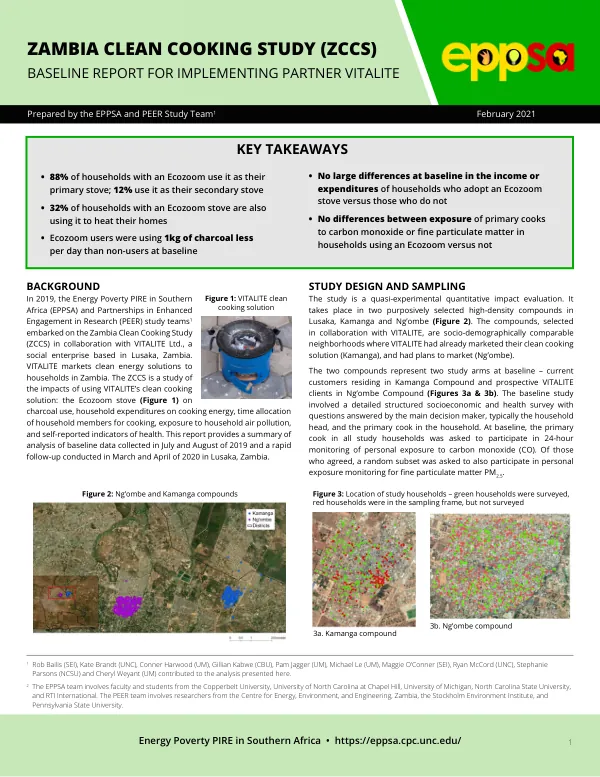
The Zambia Clean Cooking Study (ZCCS) is a quasi-experimental quantitative evaluation of the impacts of using VITALITE's clean energy solution, the Ecozoom stove, on charcoal use, household expenditures on cooking, time allocation of household members for cooking, exposure to household air pollution, and self-reported indicators of health.
2021 · 8 pages
Sign in to readA free account is required to download.
Abstract
The study was conducted in two purposively selected high-density compounds in Lusaka, Kamanga and Ng'ombe, and involved a detailed socioeconomic and health survey with questions answered by the main decision maker, typically the household head, and the primary cook in the household. The study found that 88% of households with an Ecozoom use it as their primary stove, and 12% use it as their secondary stove. Additionally, Ecozoom users were using 1kg of charcoal less per day than non-users at baseline. No large differences were found in the income or expenditures of households who adopted the Ecozoom stove compared to those who did not. Furthermore, no differences were found in exposure to carbon monoxide or fine particulate matter in households using the Ecozoom versus not. The baseline survey revealed several differences between households in Kamanga and Ng'ombe. In Kamanga, households were wealthier, more likely to have a female head of household, have older heads of household and primary cooks, and have been in Lusaka for a longer time. Within Ng'ombe, the households that adopted the Ecozoom stove were larger, had older heads of households and primary cooks, and were more likely to own their home. The study also found that most households in both compounds were connected to the national grid and used electricity as their primary source of lighting. Other commonly reported lighting sources in both compounds were candles and torches. In Kamanga, 70% of households heated their homes during the cold season, while in Ng'ombe, 70% of households used a traditional mbaula for heating. The energy access profiles of households in Kamanga and Ng'ombe were also examined. In Ng'ombe, 90% of households used a traditional mbaula as their primary stove, while in Kamanga, 88% of households used the Ecozoom as their primary stove. The study also found that households in Kamanga used the Ecozoom regularly, with 88% of households using it as their primary stove and 12% using it as their secondary stove. The economic characteristics of the households were also examined. The study found that the majority of household heads in Kamanga were working either at a salaried position or were self-employed, while in Ng'ombe, there were more people who were engaged in salaried work, the same amount who were self-employed, and the unemployment rate was higher. The study also found that the energy expenditures within the household were closely related to the amount of charcoal used per household per day. Overall, the ZCCS study provides valuable insights into the impacts of using the Ecozoom stove on household energy access, energy expenditures, and economic characteristics. The study found that the Ecozoom stove has the potential to reduce charcoal use and improve energy access in households, particularly in areas where traditional stoves are widely used.