USAID DEC
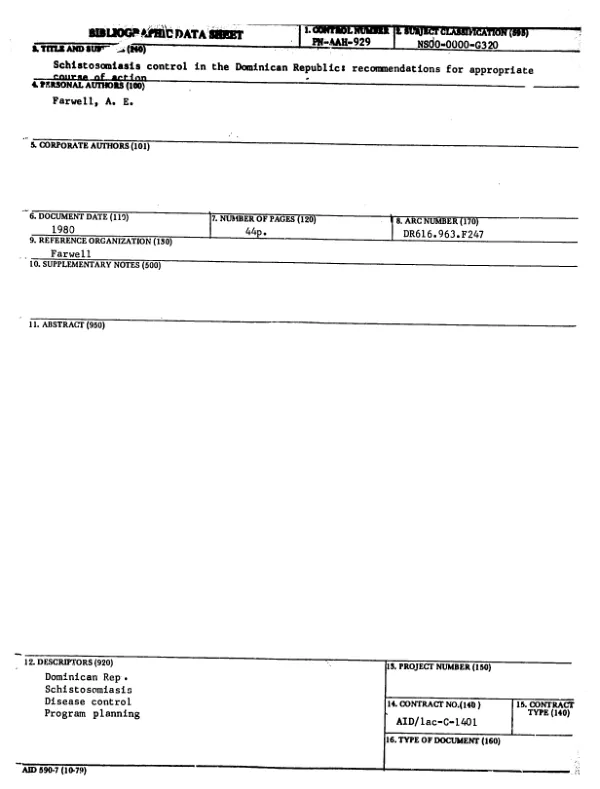
Schistosomiasis control in the Dominican Republic : recommendations for appropriate course of action
Sign inUSAID DEC
Schistosomiasis control in the Dominican Republic : recommendations for appropriate course of action
Prior to approving a request from the Government of the Dominican Republic (GODR) to USAID to provide assistance in a schistosomiasis control program, a team of scientists was called on to evaluate the present status of schistosomiasis and of ongoing eradication programs.
Farwell, Albert E. · 1970
Sign in to readA free account is required to download.
Abstract
This report presents the findings of an economic analyst contracted to work with this team, review their findings, and recommend an appropriate course of action to USAID. Current schistosomiasis programs of the Center for the Eradication of Bilharzia (CEB) rely on incorrect prevalence data, which fail to account adequately for the possible spread of schistosome parasites by migration from known areas of infection in eastern provinces. Moreover, these programs are oriented toward case treatment and haphazard extermination of the host snail Biomphalaria glabrata, rather than toward arresting further infection and mollusciciding at identified transmission points. Major reorientation of the present control effort is required if Schistosoma mansoni (bilharzia) is to be controlled adequately. To this end, the following resources can be exploited without substantial new or additional funding: academic community capability to undertake S. mansoni infection and malacological research; and village health services and education, potable water, and sanitary excreta disposal programs. Because the GODR is able to carry out the former, the author emphatically recommends that USAID assume responsibility for neither the execution nor the financing of the reoriented program. Rather, USAID should encourage program improvement by recommending to GODR an extensive survey to delineate the locations where S. mansoni infection is now found and to provide data on prevalence, intensity, and incidence of infection. Also recommended is a control program -- such as that outlined by the scientific team -- aimed at better detection and identification of transmission points; mollusciciding B. glabrata at those points; and treatment of identified S. mansoni infection. USAID should also consider geographic realignment of existing AID-supported programs to permit their beneficial application to areas of S. mansoni infection. A 19-item bibliography (1973-80) is appended.