USAID. MISSION TO OMAN
Scholarship and training project
Summarizes final evaluation (XD-ABE-788-A) of the scholarship and training subproject (SP) of the Omani-American Joint Commission (OAJC) Project.
1989
Sign in to readA free account is required to download.
Abstract
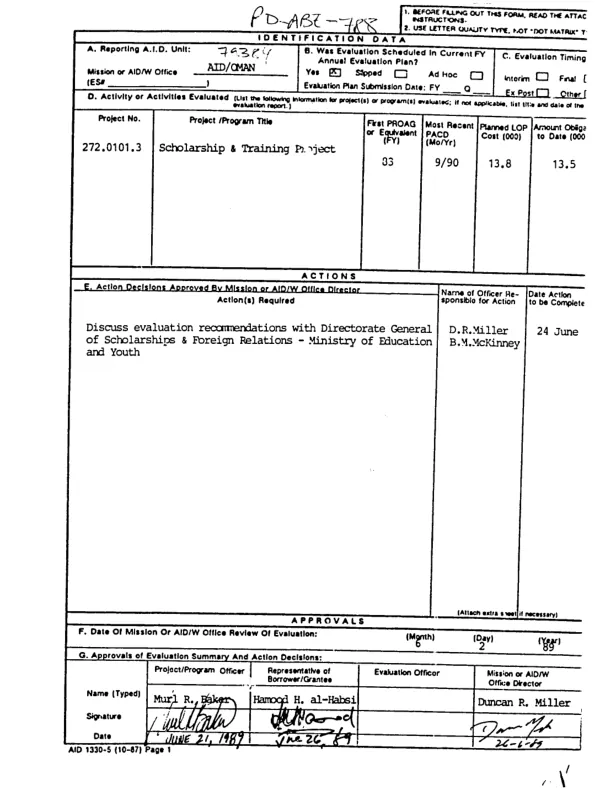
The evaluation was conducted in 5/89, a year prior to the PACD, and focuses on the short-term technical training component. Of the other two original SP components, long-term academic training was terminated after the 1987 interim evaluation, and the management information system component was evaluated separately in 9/88. The SP began in 1983. Major findings were as follows. (1) The SP exceeded its revised training targets by 40%, programming a total of 2,211 person months (pm) of training, including 1,815 pm of U.S. and third country training. (2) The SP was extremely flexible in supporting a wide variety of training opportunities and in effectively matching the type of training to the training site. There was an appropriate mix of short in-country, Arabic-language courses for in-service skill development, study tours for senior officials, specialized third country courses, and uniquely designed technical programs in the United States. This flexibility was a significant factor in the project"s success and should be maintained in future projects. (3) Training effectively addressed skill constraints in designated priority sectors. Trainees, supervisors, and individual ministries generally expressed satisfaction with the courses provided, the skills acquired, and the constraints addressed. Nevertheless, the SP covered only a small portion of the training needs of the participating ministries. (4) The termination of the project"s long-term training component was justified for the reasons stated in the interim evaluation. The following lessons were learned. (1) In future training activities, the roles and responsibilities of the contractor, the government, and the OAJC should be fully delineated to prevent misunderstandings. (2) The SP"s sector manpower assessments were generally poor in quality, undertaken before clear sector objectives had been established, and developed (in some cases) without the direct involvement of the concerned ministries. These difficulties might have been avoided with more careful planning. The A.I.D./W evaluation officer, while generally agreeing with the evaluation, notes that, at the insistence of Oman"s Directorate General of Scholarships and Foreign Relations (DGSFR), the host country implementing agency, it omits most criticism of the government. In so doing it undervalues the significant contribution of the Checchi TA team, whose burden was increased by lack of full DGSFR support. Also, the (correct) shift from long- to -short term training after 1987 revealed that the project"s institution-building objective -- especially for DGSFR -- was premature.
Related documents