USAID DEC
Science and Technology Development Journal - Natural Sciences, Vol 2, Issue 2, 2018
The species Leptobrachium leucops, a type of frog, was first described in 2011 by Stuart and colleagues based on specimens collected from the Bidoup-Núi Bà National Park in Lâm Đồng Province, Vietnam.
2018 · 8 pages
Sign in to readA free account is required to download.
Abstract
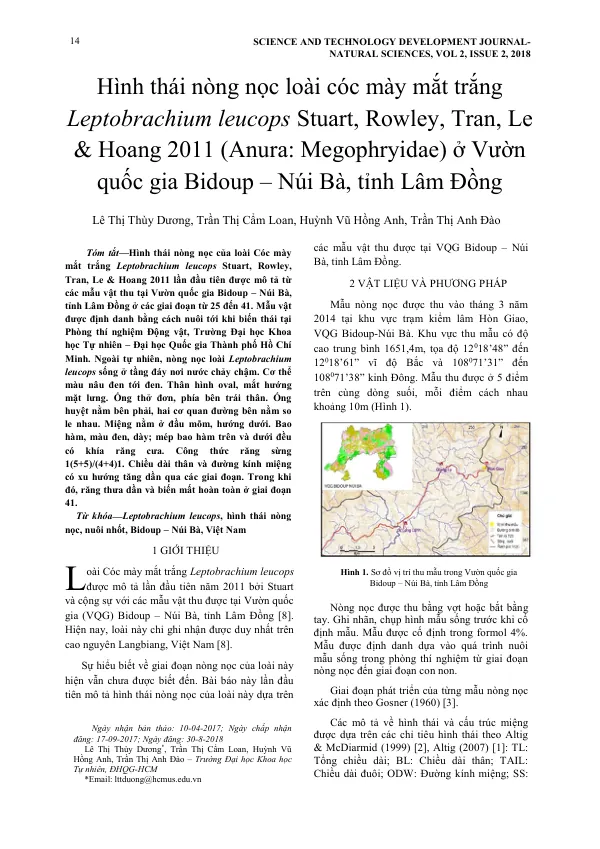
The species is characterized by its white spots on the back, brownish-black coloration, and distinctive mouth shape. The frogs have a rounded snout, a wide head, and a short, broad body. The study aimed to provide a detailed description of the morphology of Leptobrachium leucops, including its body shape, size, and coloration. The researchers collected 42 specimens of the species at different stages of development, from the tadpole stage to the adult stage. The specimens were collected from five points along a stream in the Bidoup-Núi Bà National Park. The study found that the body shape of Leptobrachium leucops changes significantly as the species develops from the tadpole stage to the adult stage. The tadpoles have a long, slender body with a rounded snout, while the adults have a shorter, broader body with a distinctive mouth shape. The researchers also found that the coloration of the species changes as it develops, with the tadpoles having a more uniform brownish-black coloration and the adults having white spots on the back. The study also examined the mouth shape of Leptobrachium leucops, which is characterized by a distinctive arrangement of teeth and a rounded snout. The researchers found that the mouth shape of the species is similar to that of other members of the Leptobrachium genus. The study provides a detailed description of the morphology of Leptobrachium leucops, which is an important contribution to the field of herpetology. The species is endemic to the Bidoup-Núi Bà National Park in Vietnam and is of interest to researchers and conservationists due to its unique characteristics and limited distribution. The researchers used a combination of morphological and taxonomic techniques to describe the species, including the examination of specimens in the laboratory and the use of specialized equipment to measure and record the characteristics of the species. The study provides a detailed description of the body shape, size, and coloration of Leptobrachium leucops, as well as its mouth shape and other distinctive characteristics. The study has implications for the conservation of Leptobrachium leucops and other members of the Leptobrachium genus. The species is endemic to a limited geographic area and is of interest to researchers and conservationists due to its unique characteristics and limited distribution. The study provides a detailed description of the morphology of the species, which can be used to inform conservation efforts and to identify areas where the species may be found. The study also highlights the importance of continued research and conservation efforts for Leptobrachium leucops and other members of the Leptobrachium genus. The species is of interest to researchers and conservationists due to its unique characteristics and limited distribution, and continued research and conservation efforts are necessary to ensure the long-term survival of the species. The study provides a detailed description of the morphology of Leptobrachium leucops, which is an important contribution to the field of herpetology. The species is endemic to the Bidoup-Núi Bà National Park in Vietnam and is of interest to researchers and conservationists due to its unique characteristics and limited distribution. The study provides a detailed description of the body shape, size, and coloration of Leptobrachium leucops, as well as its mouth shape and other distinctive characteristics.