USAID. MISSION TO EGYPT
Science and technology for development
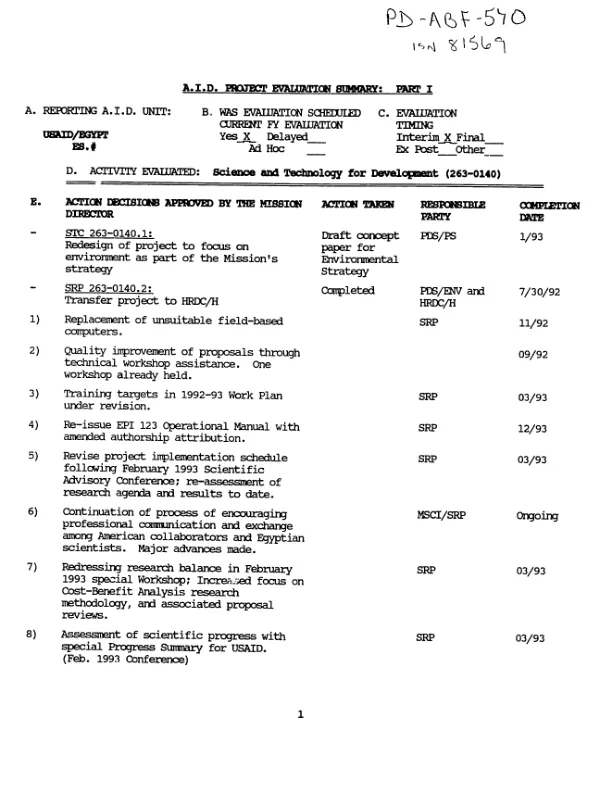
Summarizes individual interim evaluations (PD-ABF-572/576) of the umbrella Science and Technology for Development Project in Egypt and its four component projects.
1993
Sign in to readA free account is required to download.
Abstract
The evaluations covered the period 1986-1991/92. The first component project, Science and Technology Cooperation (STC), seems well-launched toward its major objective, which is selling the R&D approach to Egypt"s"s industrial and local government sectors, and thus helping to strengthen linkages between the R&D community and these two sectors. The STC Secretariat (the Government of Egypt"s implementing agency) is a lean operation with well-qualified staff and high morale. Procedures are well thought out and, following some initial difficulties, appear to be working well. The Secretariat has awarded 33 research contracts, conducted a variety of workshops and seminars, and published newsletters and other documents. The project also prepared 49 feasibility studies for small, labor-intensive agricultural/industrial subprojects (SP"s) and distributed them to about 2,000 young entrepreneurs; 3 of the SP"s are being demonstrated in the 6th of October City. The STC project also supports the Egyptian National Scientific and Technical Information Network and its extension to regional universities. The schistosomiasis research project is a promising effort that is for the most part on schedule; its major focus is finding a vaccine against schistosomiasis. The project has awarded 46 research grants, including 29 full grants for about $9 million and 17 Young Scientist grants for about $340,000. The energy conservation and efficiency project is being effectively implemented and progressing well toward its objectives. Sixteen cost-sharing energy conservation SP"s have been funded, nine in the private sector and seven in the public sector; total energy savings from these SP"s are expected to be $3.4 million per year. Some 800 plant and other personnel have been trained in energy conservation. The energy manpower development project is meeting a serious need by developing personnel for Egypt"s petroleum and electricity sectors. Only the technical and management training component can be considered successful at this time, however. The training facilities upgrading and personnel development components started late and are experiencing implementation difficulties. One lesson was learned: the umbrella mechanism provided only minimal value, since each component project stood on its own. The mechanism did facilitate start-up, but other mechanisms could have done the same. The projects will be re-directed toward a more environmental focus, in keeping with USAID/E"s new priorities.
Related documents
![Local development II [LD II], 263-0182](https://covers.devme.ai/gen/36480.webp)