USAID. MISSION TO EGYPT
Small farmer production project
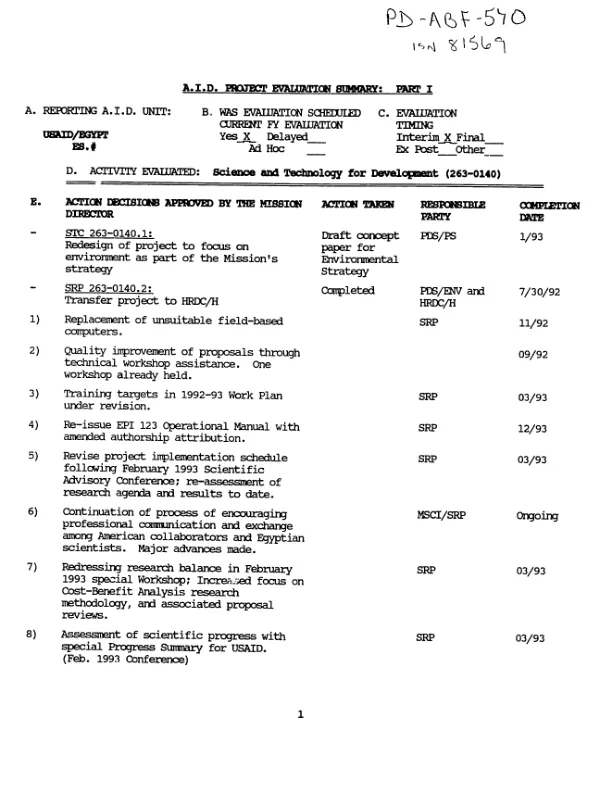
Evaluates pilot project to develop an improved, replicable small farm credit and input delivery system in three Egyptian governorates.
Ware, T.; Molldrem, V. · 1985
Sign in to readA free account is required to download.
Abstract
PES covers the period 3/83-6/85 and summarizes an attached evaluation (XD-AAS-315-A). The pilot project has successfully made credit more readily available to small farmers at near-market interest rates (14%) and has freed provision of credit and inputs from prevailing price and quota controls. An active, expanding credit operation in 38 village banks, including total coverage of three districts, has made 41,563 loans totaling LE 34 million and involving 28,000 farmers; of these, 22% were to tenant farmers, 2% to landless farmers, and 13% to women. Repayment rates are 99%. Bank management, originally very skeptical about lending without heavy collateral, now has a strong commitment to the loans; project credit, input delivery, and extension activities have all contributed to overall performance. The proposed expansion of the project approach to eight new governorates is justified by high expected rates of return (ROR"s): the internal economic ROR on current activities is estimated at 31% excluding the construction component, and 20% overall. Certain activities have much higher ROR"s (e.g., 800% for selected extension activities). Returns are highest for high-value, limited-demand crops (plans for national replication should consider this). Livestock and poultry enterprises increase net income by an estimated one-third over traditional crops alone. Wider replication, while administratively feasible, requires careful planning, commitment of counterpart institutions, and training. Certain key tasks, e.g., development of a procedures manual and an improved accounting system, are unfinished; too rapid an expansion may strain the system. Overlap with the current project and its TA team is critical to successful replication, as is integration of the project structure into the Principal Bank for Development and Agricultural Credit. Lessons learned are that farmers will pay higher than subsidized prices for inputs and interest when credit is available and investments are profitable, and that virtually 100% repayment can be achieved when loans are for financially viable investments, without excessive collateral. Eight recommendations for project expansion are included. (Near East Bureau abstract, modified)
![Local development II [LD II], 263-0182](https://covers.devme.ai/gen/36480.webp)