USAID DEC
Second Quarterly Progress Report, January 1st – March 31, 2020: People at Peace (Lafia)
Sign inMERCY CORPS INTERNATIONAL
Second Quarterly Progress Report, January 1st – March 31, 2020: People at Peace (Lafia)
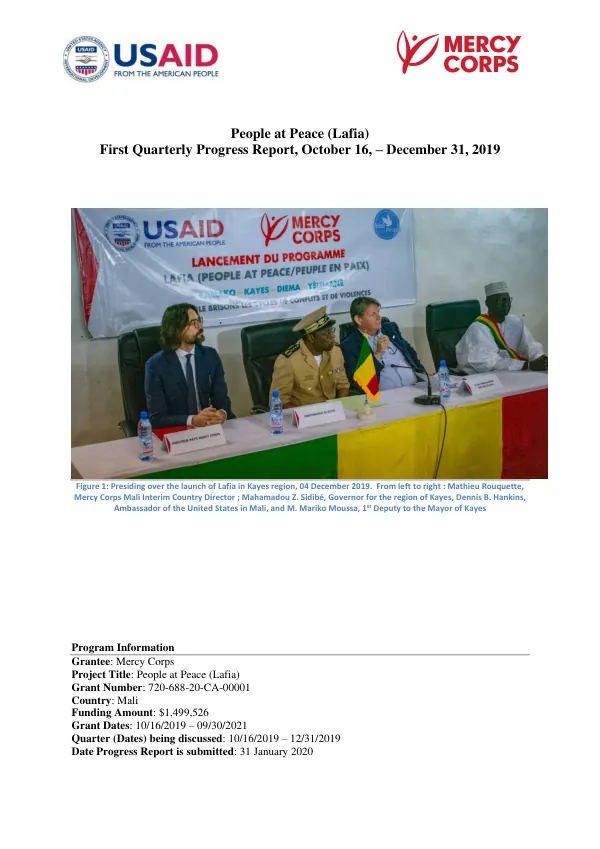
The People at Peace (Lafia) program in Mali began in October 2019 with a two-year grant of $1,499,526 from USAID's Conflict Management and Mitigation program.
2020 · 11 pages
Sign in to readA free account is required to download.
Abstract
The program aims to increase resilience to conflict and violent extremism in southern and western Mali through a people-to-people approach. The program's three interlinked objectives are to reduce youth vulnerability to participating in conflict and violent extremism, resolve inter-group conflicts peacefully, and engage local communities with government authorities and civil society actors in implementing national policies that prevent violent extremism and promote reconciliation. The program's scope of work focuses on addressing the root causes of conflict and violent extremism in Mali, including perceived injustices, lack of economic opportunities, and the absence of functioning government services. The program also aims to address the competition for land and water between Fulani pastoralists and Bambara and Soninke farmers in rural areas, which may trigger the spread of violence if left unmanaged. During the second quarter of 2020, the program finalized its start-up activities, including the signature of a Memorandum of Understanding with Think Peace, the completion of baseline data collection and report writing, and the presentation of baseline study results. The program also developed COVID-19 sensitive assessment SOPs and a contingency plan to ensure operational continuity while taking into consideration the security and safety of the team and beneficiaries. The program's activities during the second quarter focused on three objectives. Objective 1 aimed to reduce youth vulnerability to participating in conflict and violent extremism through a mapping exercise of vulnerability to violence and sources of resilience. The program completed the collection phase for the District of Bamako and started organizing the collection in Kayes region. Objective 2 aimed to resolve inter-group conflicts peacefully and reduce conflict drivers through the development of an Early Warning System. The program began consultations at the cercle level to discuss criteria for selecting monitors. Objective 3 aimed to engage local communities with government authorities and civil society actors in implementing national policies that prevent violent extremism and promote reconciliation. The program initiated a working meeting with two other groups, CNJ and UJMMA, who will be involved in the implementation of these activities. The main challenge faced during this quarter was the COVID-19 pandemic, which created a situation that required the program to adapt its activities. The program developed a contingency plan that allows it to maintain operational continuity while taking into consideration the security and safety of the team and beneficiaries. The socio-political context in Mali during the last quarter was marked by the recommencement of meetings of the Algiers Peace Agreement Monitoring Committee, the organizing of the first round of the legislative election, teachers' demonstrations, and the first cases of COVID-19 in the country. In the Kayes region, tensions related to the cultural practice of slavery continue in some localities, and attacks by radical armed groups and incidents related to the cultural practice of slavery have occurred. The conflict incident tracking map shows these trends at the regional level over the past 12 months. The program's finalization of start-up activities during this quarter included onboarding the national partner, Think Peace, and the completion and presentation of the baseline study and results. The program has made significant progress in its activities during the second quarter, despite the challenges posed by the COVID-19 pandemic.