MERCY CORPS INTERNATIONAL
MC Mali Lafia FY20 Annual Report
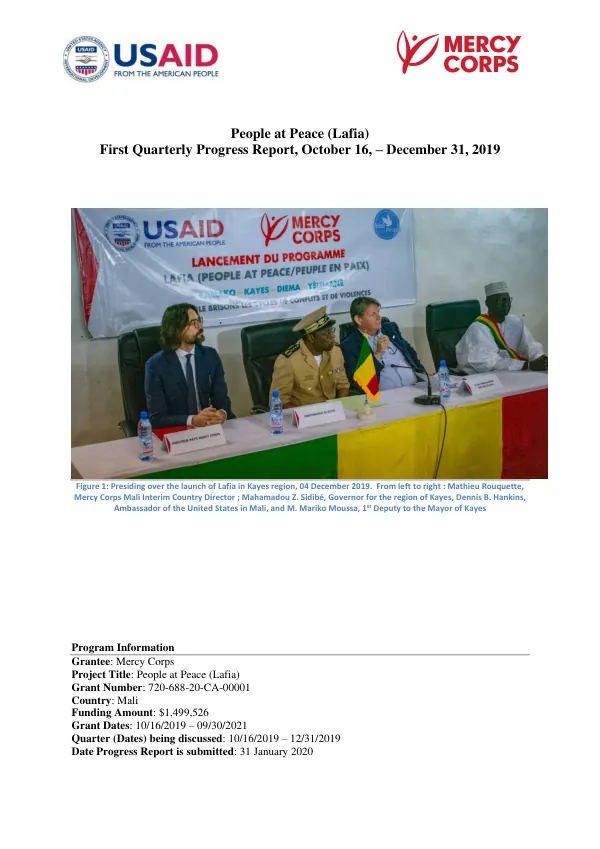
The Lafia program, implemented by Mercy Corps and Think Peace, aims to support urban and rural communities in southern Mali to increase resilience to conflict and violent extremism.
2020 · 33 pages
Sign in to readA free account is required to download.
Abstract
The program, which began in October 2019, has a budget of $1,499,526 and is expected to run for two years. The program's overall goal is to increase local capacities to counter drivers of conflict and extremism through a people-to-people approach that brings together political and religious leaders and young men and women from different ethnic groups. The program has three interlinked objectives: 1) Youth reduce their vulnerability to participating in conflict and violent extremism; 2) Traditional, religious, and female leaders, and government officials resolve inter-group conflicts peacefully and reduce conflict drivers; and 3) Local communities actively engage with relevant government authorities and civil society actors in the implementation of national policies that prevent violent extremism and promote reconciliation. During Fiscal Year 2020, the program made significant progress in achieving its objectives. Under Objective 1, youth associations conducted a mapping exercise of vulnerability to violence and sources of resilience, and 60 Sport for Change (S4C) Clubs were set up to involve 2,000 youth at risk of participation in conflict in identification and resolution of conflict in collaboration with youth leaders. Additionally, youth designed and implemented action plans that addressed risk factors for violence, and awareness-raising initiatives were implemented to prevent violence following the events of May 11, 2020 in Kayes. Under Objective 2, traditional, religious, women, and government leaders increased their capacity in dispute resolution through training sessions, and participated in conflict resolution forums to share lessons and develop/adapt Early Warning Early Response systems (EWER) to needs of zones of intervention. The EWER system was set up in 9 communes and was functioning in 8 communes. The program also made progress in adapting to the COVID-19 pandemic, developing COVID-19 sensitive assessment SOPs, and implementing remote-based methods of data collection, limiting participant numbers at focus group discussions, and adding usage of handwashing stations and contactless thermometers for entry/exit points of program activities. The Lafia program has achieved several key accomplishments, including the establishment of 60 S4C clubs, the training of 60 coaches, and the implementation of S4C activities. Additionally, the program has made progress in increasing the capacity of traditional, religious, women, and government leaders in dispute resolution, and has set up the EWER system in 9 communes. The program's contextual information highlights the challenges faced by the country, including the COVID-19 pandemic and socio-political tensions that led to the dissolution of the national government and ongoing political transition. Despite these challenges, the program has made significant progress in achieving its objectives and has established a strong foundation for future success. The program's next quarter will focus on implementing planned activities, including the continuation of S4C activities, the expansion of the EWER system, and the implementation of awareness-raising initiatives to prevent violence. The program will also continue to adapt to the COVID-19 pandemic and its consequences, and will work to ensure operational continuity. Overall, the Lafia program has made significant progress in achieving its objectives and has established a strong foundation for future success. The program's focus on increasing local capacities to counter drivers of conflict and extremism, and its people-to-people approach, make it a valuable contribution to the efforts to promote peace and stability in southern Mali.