MERCY CORPS INTERNATIONAL
SECOND QUARTERLY REPORT FOR USG FY 2011
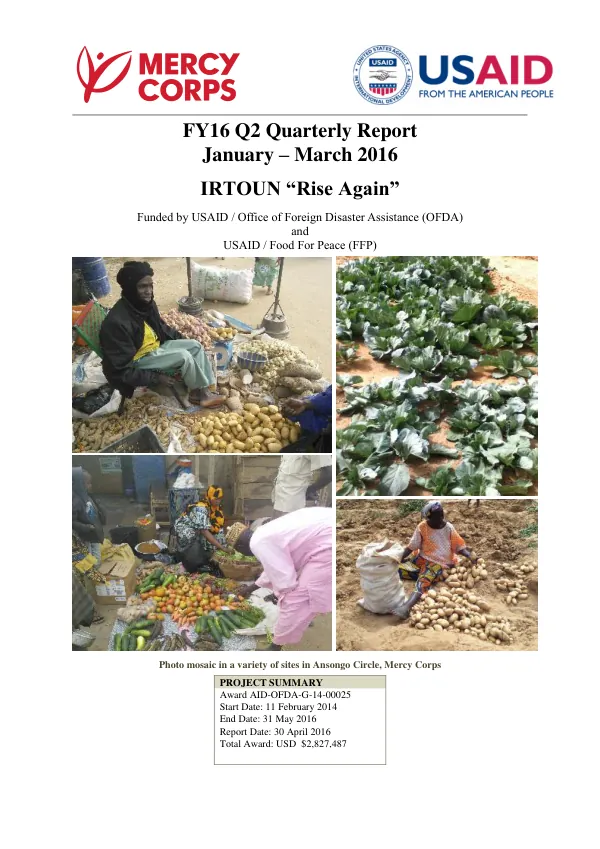
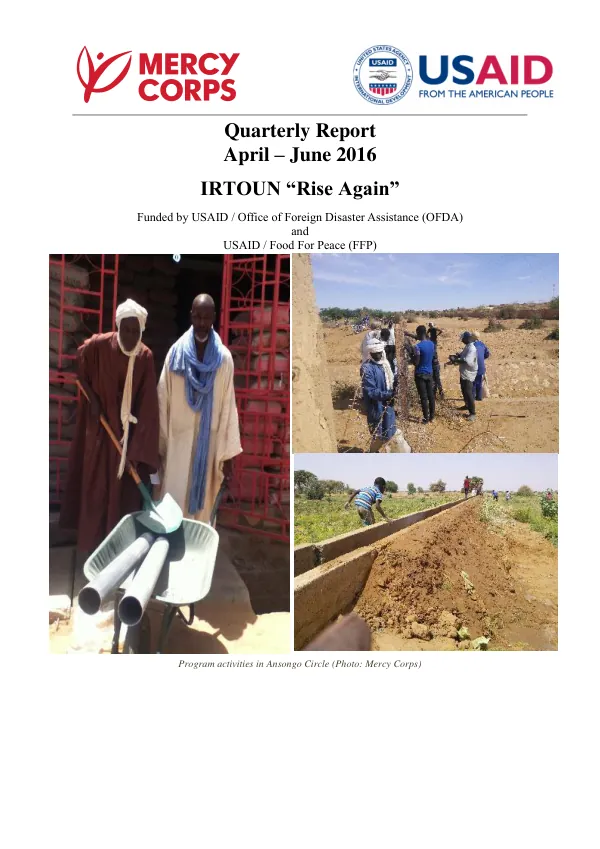
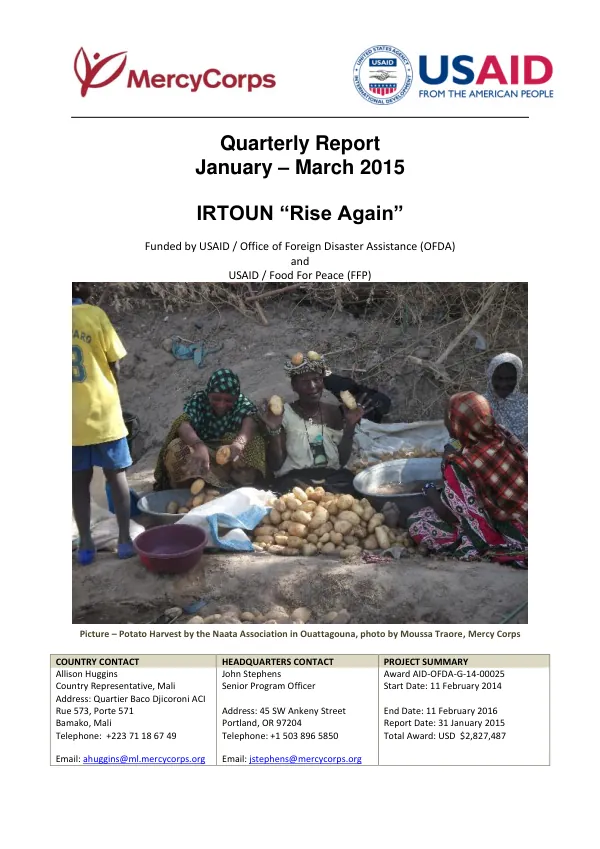
The Irtoun program, funded by USAID's Office of Foreign Disaster Assistance (OFDA), aims to enhance food security and economic resilience in communities recovering from conflict in northern Mali.
2016 · 13 pages
Sign in to readA free account is required to download.
Abstract
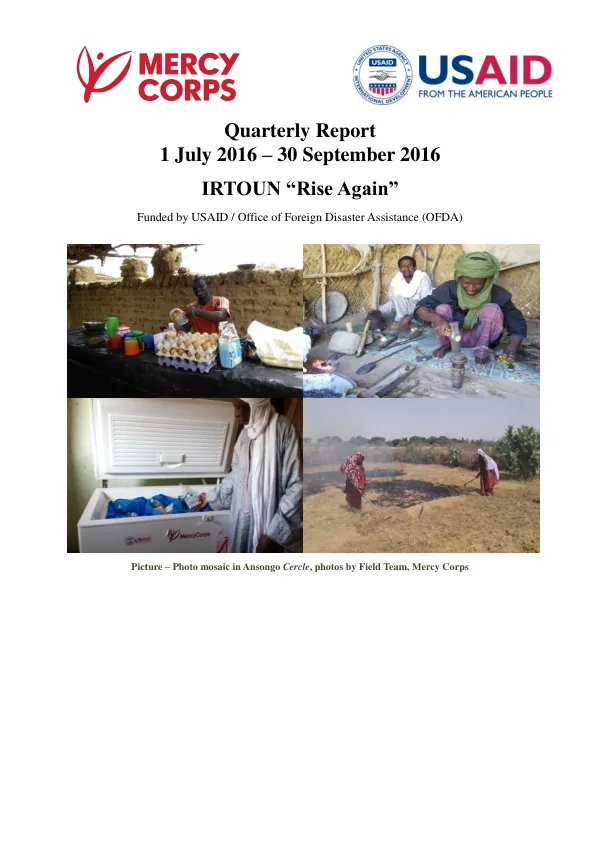
The program operates in Ansongo Circle of Gao Region and in Timbuktu and Gourma Rharous Circles of Timbuktu Region. Initially funded for two years from 2014 to 2016, the program was extended through two no-cost extensions and received a cost modification to extend the project until 2017. During the quarterly reporting period from July to September 2016, the program achieved several objectives. In the "Irtoun 1" sector, 45 village committees responsible for animal feed management opened accounts with microfinance institutions, and awareness-raising activities were conducted on best practices for animal feed harvesting and storage. Additionally, advisory support and monitoring were provided to 22 veterinary assistants, and follow-up was conducted with 53 micro-entrepreneurs on the management of their small enterprises. In the "Irtoun 2" sector, a kick-off meeting was held in September 2016 to review the intervention strategy, budget, targets, timeline, procurement plan, and staffing plan. Support was provided to 51 market gardening groups who participated in Irtoun I to prepare for the October 2016 vegetable planting season. Identification of 25 new market gardening groups in Ansongo Circle and ongoing identification of 50 groups in Timbuktu and Gourma Rharous Circles were also conducted. Staff recruitment for Irtoun II in Ansongo and Timbuktu was completed. The program has achieved significant milestones, including the recovery of productive agricultural livelihoods and the increase of incomes by engaging in local markets. Immediate household needs are addressed through cash-for-work activities and animal feed vouchers. The program also facilitates the recovery of market gardening activities, addresses the needs of pastoralists for improved fodder and healthcare services, and promotes behavior change around fodder conservation and planning. The food security situation in the region has declined due to the lean period, and vulnerable households are in need of food assistance. The 2016-2017 agricultural season began during the past quarter, with farming operations starting on small village irrigated plots, in fully or partially submerged rice fields, and in non-river-fed fields. However, many water pumps are in disrepair, reducing production capacity and incurring costs to rural producers. Rice planting was limited by low volumes of rainfall in August and threatened by the rise of the river that flooded many rice-producing lowlands, causing a shortage of exploitable land. The flooding caused significant concern for rice producers and households situated close to the river, whose fields and houses were threatened. As a result of the delay in the rainy seasons, rice fields were flooded without the rice plants reaching a suitable stage to support the water level, causing some producers to lose their investment. The damage was more prominent in Mopti and southern circles of Timbuktu, such as Dire and Niafunke, and did not cause significant damage in project areas. Many farmers across Ansongo circle fear a poor harvest following heavy rains, an early end to the rainy season, and its poor distribution in time and space, followed by a proliferation of crickets that destroyed young shoots.
Related documents