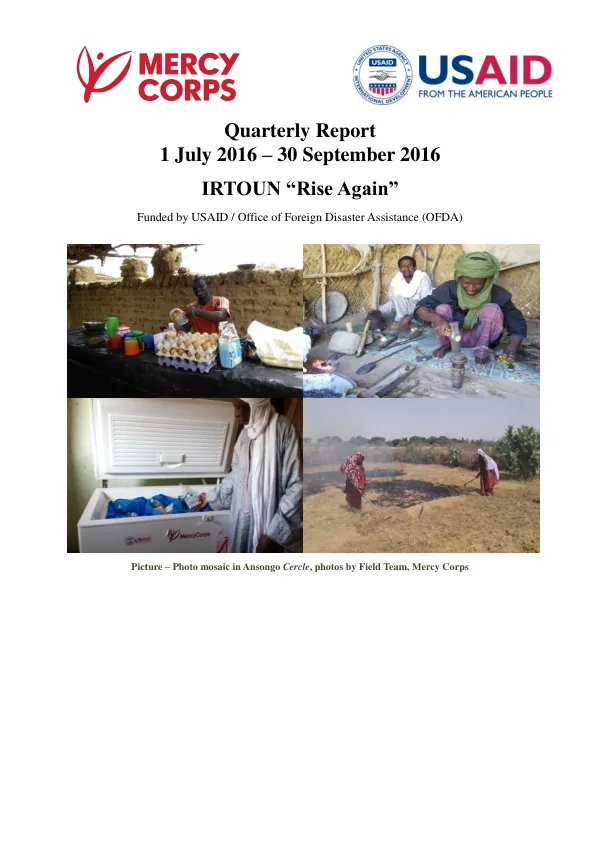
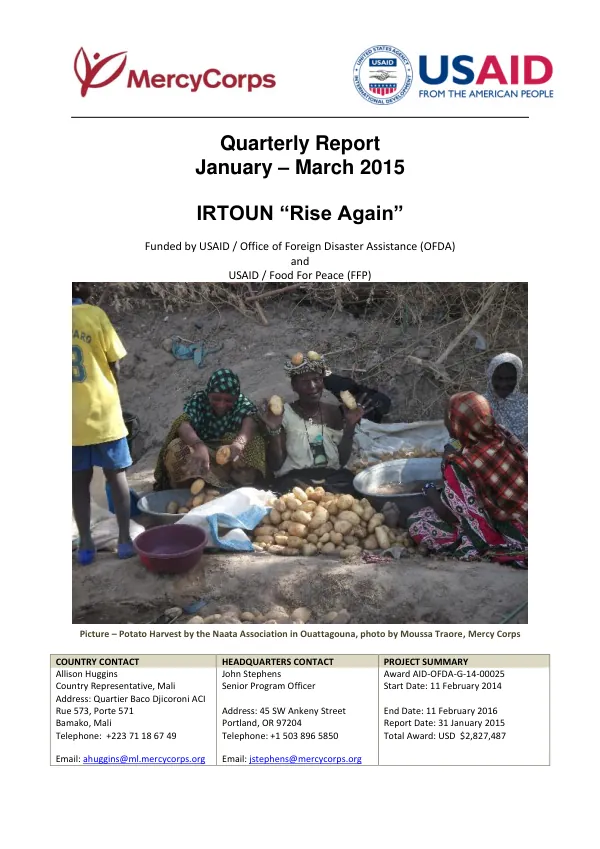
MERCY CORPS INTERNATIONAL
SECOND QUARTERLY REPORT FOR USG FY 2011
The Irtoun program, funded by USAID's Office of Foreign Disaster Assistance (OFDA) and Food for Peace (FFP), aims to enhance food security and economic resilience of communities recovering from conflict in Ansongo, Northern Mali.
2016 · 10 pages
Sign in to readA free account is required to download.
Abstract
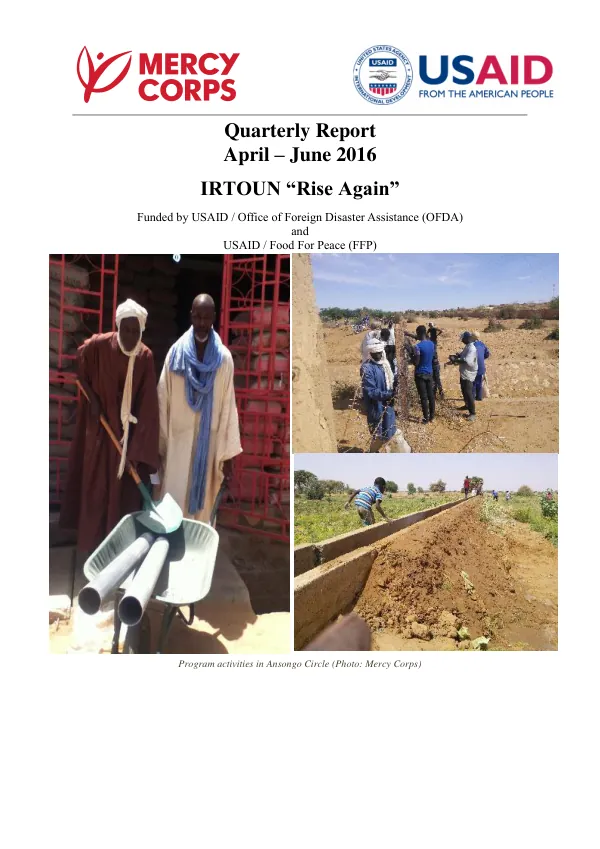
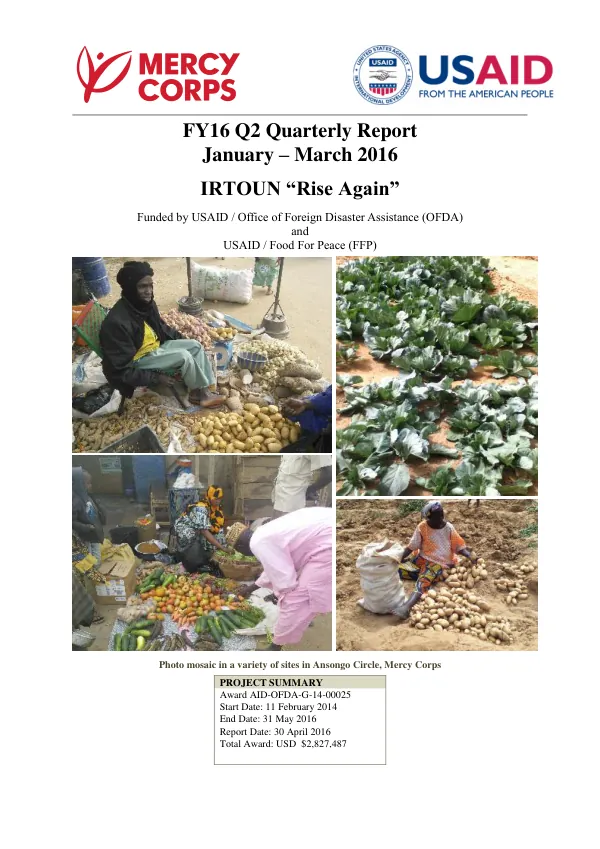
The program, implemented by Mercy Corps, focuses on strengthening agricultural production, helping vulnerable families protect their animal assets, and restoring livelihoods while building longer-term economic resilience. The objectives of the program are to help vulnerable households in the Ansongo circle recover productive agro-pastoral livelihoods and to allow vulnerable households to restore income-generating activities and withstand economic shocks. Immediate food security needs are being addressed through vouchers-for-work (VfW) redeemable for food and non-food items as well as animal feed vouchers. The program also facilitates the recovery of market gardening activities, including the most important cash crops of the region, and addresses the needs of pastoralists for improved fodder and health care services for their livestock. During the second quarter of 2016, the program achieved several key milestones. Community animal health workers (CAHWs) were trained on business planning and entrepreneurship skills to support long-term financial autonomy and enhance small business management skills. A total of 800 agro-pastoralists were identified to benefit from animal feed voucher distributions in the next quarter. The vegetable cooperative in Gomno was supported by providing fuel for their water pump and rehabilitating their fencing. Monitoring of agricultural production levels of supported gardening groups was also conducted. The program has exceeded its objectives per its implementation plan and is working toward the close-out of current activities. As part of this process, Irtoun is working to support the autonomy and self-sufficiency of beneficiaries by working with communities to plan for their livelihood needs for the next year. Mercy Corps continues to coordinate with local stakeholders and Government technical services to ensure that the program addresses local needs and supports communities to go beyond recovery to reinforce resilience within the targeted communities. The program has made significant progress in achieving its objectives. A total of 29,547 beneficiaries were reached in the second quarter of 2016, exceeding the target of 25,060 beneficiaries. The cumulative number of beneficiaries reached is 54,950, representing 7,850 households. The program has also made progress in improving agricultural production, with average yields proving to be slightly lower than last year but higher than years previous in the program sites. The yields obtained by supported potato farmers vary from 12 to 34 tons per hectare, which is an increase over production from the baseline from last year. The security situation in the region remains unstable, with frequent armed attacks and thefts reported. The program has been affected by the insecurity, with humanitarian access and aid delivery inhibited. However, the program continues to operate in the region, providing essential support to affected populations in rural communities. The program's efforts to support the autonomy and self-sufficiency of beneficiaries are crucial in building longer-term economic resilience and reinforcing resilience within the targeted communities.
Related documents