MERCY CORPS INTERNATIONAL
SECOND QUARTERLY REPORT FOR USG FY 2011
The Irtoun program, funded by USAID's Office of Foreign Disaster Assistance (OFDA) and Food for Peace (FFP), aims to enhance food security and economic recovery in Ansongo, Northern Mali.
2016 · 11 pages
Sign in to readA free account is required to download.
Abstract
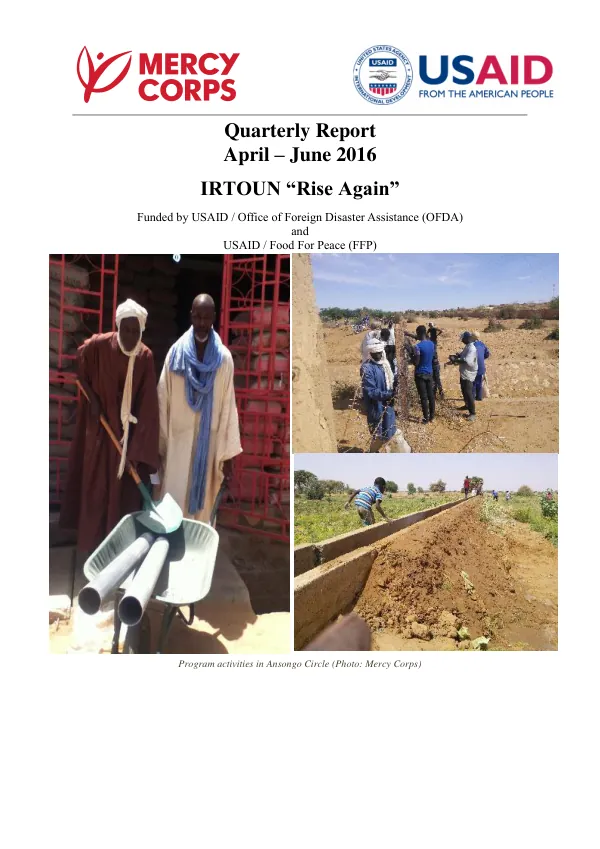
The program is designed to strengthen agricultural production, help vulnerable families protect their animal assets, and restore livelihoods while building longer-term economic resilience. Key activities include supporting nine targeted vegetable producer associations, refresher training for 150 young entrepreneurs, and distribution of animal feed vouchers to 800 agro-pastoralists. Implementation of the program is on track to meet or exceed its objectives, with a total of 36,869 beneficiaries reached in the third quarter of FY16. The program has achieved significant progress in its objectives, including a 27% increase in household income among program participants compared to the control group. The program's contextual update highlights the ongoing challenges faced by farmers and pastoralists in the region. Vegetable gardening campaigns have reached an end, and markets are well-stocked with cereals and vegetables, although prices continue to increase. The animal health situation is stable, but animals have begun to lose weight due to the lean season, leading to a decline in animal prices. The food security situation is declining as the lean season continues, with vulnerable households in need of assistance beginning in May. The implementation of the peace accord is underway, with a meeting of the Monitoring Committee held in Bamako in the third quarter. However, the process has been met with vocal opposition from communities in the North, who oppose the non-representative and non-participatory nature of the selection and installation of interim authorities. The security situation has deteriorated significantly, with an increase in armed attacks, including clashes between self-defense groups, shelling of military camps, and IED explosions along roadways. The program's performance summary highlights its progress in achieving its objectives. In Sector #1, vulnerable households in Ansongo circle have recovered productive agricultural livelihoods, with 17,136 beneficiaries reached in the reporting period and 45,052 beneficiaries cumulatively. The program has also made significant progress in improving agricultural production, with a projected increase in the number of months of food self-sufficiency due to distributed seed systems and agricultural inputs. Geographic areas targeted by the program include the Gao Region of Northern Mali, Ansongo circle, and the communes of Bourra, Ouattagouna, Ansongo, and Bara. The program has achieved significant progress in its indicators, including the number of animals benefiting from or affected by livestock activities, the number of people benefiting from livestock activities, and the projected increase in the number of months of food self-sufficiency due to distributed seed systems and agricultural inputs.
Related documents