THE CADMUS GROUP, INC.
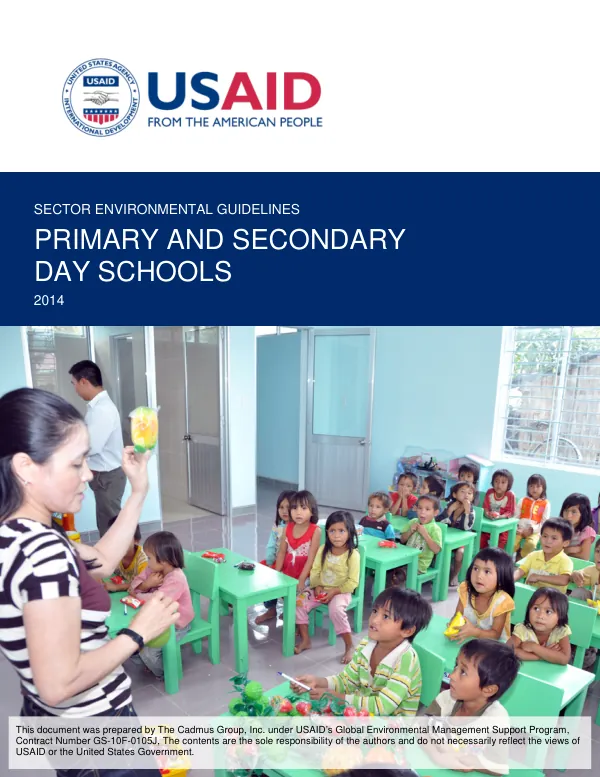
Sector Environmental Guidelines: Primary and Secondary Day Schools
Formal education is essential to social and economic development, and school facilities are critical to formal education.
2014 · 30 pages
Sign in to readA free account is required to download.
Abstract
USAID's support to the education sector often includes funding for the construction, expansion, and/or rehabilitation of schools. Environmentally sound design and management (ESDM) of schools is crucial in creating a school environment that facilitates learning, safeguards the health and safety of students, reinforces basic hygiene behaviors, and assures that school facilities will be durable, returning social benefits over many years on the substantial investment they represent. In compliance with USAID Environmental Procedures, a Negative Determination with Conditions is often recommended for small-scale renovations or limited construction of schools. However, larger schools or a program to develop many smaller schools in a developing country may be a Positive Determination and require an Environmental Assessment. ESDM requires siting, design, and materials choices that are responsive to local environmental conditions, appropriate environmental management of the construction process, minimizing environmental contamination, and provision of safe, adequate water supplies and energy supplies. Failure to address these issues in school design and management results in environmental and health risks that may diminish or negate many of the benefits schools are intended to deliver. School facilities can become breeding grounds and transmission points for disease, provide physical environments unfavorable for learning or physically unsafe, have adverse impacts on the local environment, and deteriorate rapidly. This chapter describes how these potential effects and outcomes arise and recommends mitigation and monitoring measures to prevent or reduce them, both in design and operation. Effective mitigation is much easier when potential adverse outcomes are identified and addressed early in the design and construction process. This guidance is intended as an environmental supplement to traditional engineering, construction, or technical standards and is targeted at the construction and ongoing maintenance of day (non-boarding) schools. It does not address environmental management of science laboratories, vocational workshops, or school farms, which impose additional environmental design and management needs beyond the scope of this guidance. Climate change is becoming a significant concern for many communities, with changes in temperatures, rainfall patterns, and extreme weather events exacerbating existing environmental challenges. Schools can play a critical role in mitigating the impacts of climate change by incorporating sustainable design principles, reducing energy consumption, and promoting environmental awareness among students. This chapter provides guidance on how to design and manage schools in a way that minimizes their environmental footprint and promotes sustainability. The Sector Environmental Guidelines for Primary and Secondary Day Schools provide concise, plain-language information on the typical, potential adverse impacts of activities in these sectors, how to prevent or mitigate these impacts, and how to minimize vulnerability to climate change. The guidelines are advisory only and are not official USAID regulatory guidance or policy. They are intended to support environmentally sound design and management of schools by providing general activity design guidance, specific design, construction, and operating measures, and detailed resources for further exploration of these issues.
Related documents