USAID
Improving the Quality of Education in Afghanistan
Improving the Quality of Education in Afghanistan began with the recognition that the country's students performed lower than their peers in neighboring countries.
55 pages
Sign in to readA free account is required to download.
Abstract
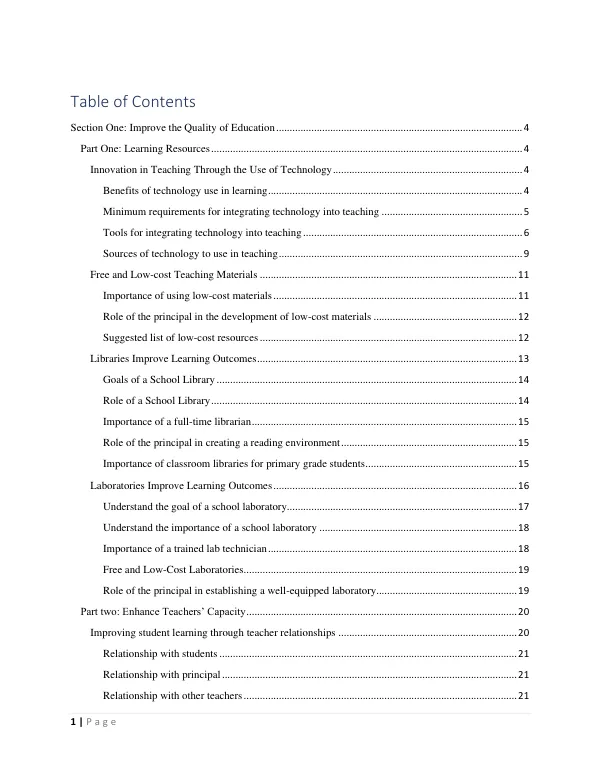
Grade 6 students in Afghanistan scored at the equivalent or lower level of Grade 4 students in countries such as Iran, Azerbaijan, and Kazakhstan. The primary reasons for this lower performance included a lack of professional teachers, limited access to teaching-learning materials, inadequate classroom environments, the teacher-centered teaching method, and insecurity in certain areas of the country. Studies have shown that these drivers of low-quality education can be addressed through the use of technology. As a result, it is essential for school principals to integrate technology into teaching. This can be achieved by implementing various tools and resources, such as digital learning platforms, educational software, and online educational materials. The use of technology can enhance the quality of education by providing students with access to a wide range of learning resources, improving teacher training, and creating a more engaging and interactive learning environment. The benefits of technology use in learning are numerous. It can improve student engagement, increase access to educational resources, and enhance teacher training. Additionally, technology can help to create a more inclusive learning environment by providing students with disabilities with equal access to educational resources. To integrate technology into teaching, schools must establish minimum requirements, such as ensuring that all teachers have access to technology and that students have the necessary skills to use it effectively. Schools can also utilize free and low-cost teaching materials to enhance the quality of education. These materials can be sourced from various organizations, including non-governmental organizations (NGOs) and government agencies. The use of low-cost materials can help to reduce the financial burden on schools and make education more accessible to students from low-income backgrounds. Principals play a crucial role in the development of low-cost materials, and they should work closely with teachers and other stakeholders to identify the most effective resources. Libraries also play a vital role in improving learning outcomes. A well-equipped library can provide students with access to a wide range of educational resources, including books, journals, and online databases. The goals of a school library include providing students with access to information, promoting a love of reading, and supporting student learning. Principals should work closely with librarians to create a reading environment that encourages students to read and learn. Laboratories are another essential component of a school's infrastructure. They provide students with hands-on experience in science, technology, engineering, and mathematics (STEM) subjects. The goal of a school laboratory is to provide students with a safe and well-equipped space to conduct experiments and learn about scientific concepts. Principals should work closely with teachers and lab technicians to establish a well-equipped laboratory that meets the needs of students. In the next section, we will discuss the importance of enhancing teachers' capacity to improve student learning outcomes. This includes improving teacher relationships with students, principals, and other teachers, as well as providing teachers with ongoing professional development opportunities. Principals play a crucial role in enhancing teachers' capacity, and they should work closely with teachers to identify areas for improvement and provide support and resources to help them develop their skills.