USAID DEC
Sector Reform and Utility Commercialization Program: Scope of Work for Jamaican Non-Technical Loss Reduction Workshop
Sign inDELOITTE INC.
Sector Reform and Utility Commercialization Program: Scope of Work for Jamaican Non-Technical Loss Reduction Workshop
The Sector Reform and Utility Commercialization Program (SRUC) Task Order aims to promote utility commercialization and equitable, effective reforms in developing countries' electricity systems.
2018 · 4 pages
Sign in to readA free account is required to download.
Abstract
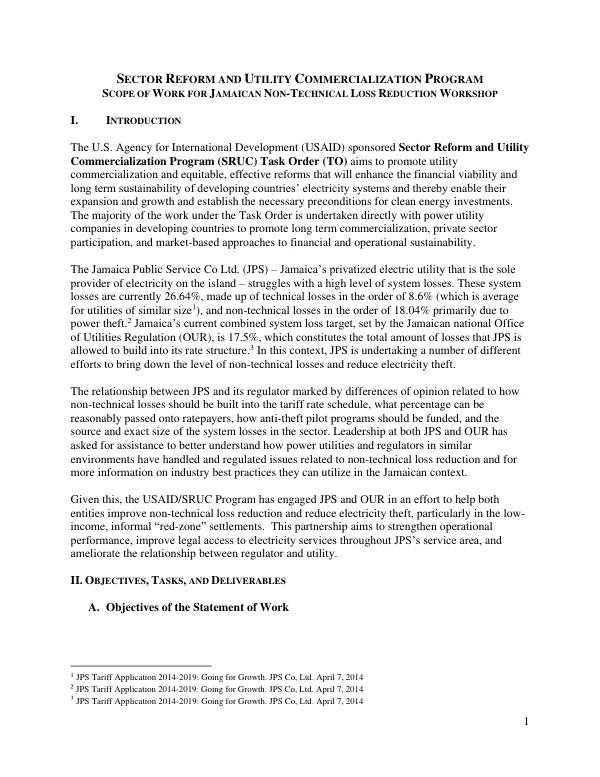
The program is sponsored by the U.S. Agency for International Development (USAID) and focuses on enhancing the financial viability and long-term sustainability of electricity systems. The program's primary objective is to enable the expansion and growth of electricity systems and establish the necessary preconditions for clean energy investments. The Jamaica Public Service Co Ltd. (JPS), Jamaica's privatized electric utility, struggles with a high level of system losses, primarily due to non-technical losses in the order of 18.04%. These losses are currently 26.64%, exceeding the Jamaican national Office of Utilities Regulation's (OUR) combined system loss target of 17.5%. JPS is undertaking efforts to reduce non-technical losses and electricity theft, but the relationship between JPS and OUR is marked by differences of opinion related to how non-technical losses should be built into the tariff rate schedule. To address these challenges, the USAID/SRUC Program has engaged JPS and OUR in an effort to improve non-technical loss reduction and reduce electricity theft, particularly in low-income, informal "red-zone" settlements. The partnership aims to strengthen operational performance, improve legal access to electricity services, and ameliorate the relationship between regulator and utility. The primary objective of this task is to organize and implement an international workshop for JPS and OUR on best practices for non-technical loss reduction for power utilities in low-income communities in developing countries. The workshop will focus on how to reduce non-technical loss that originates from theft as well as standard regulatory oversight of utilities facing similar challenges. Technical staff from power utilities and regulators will present potential solutions, case studies, and best practices to JPS and OUR. The consultant team will carry out several phone calls and potentially an in-person planning session with JPS and OUR to capture the issues facing these entities and ensure the workshop speakers' presentations address the most important issues related to non-technical loss reduction in Jamaica. The consultant team will recruit experts from six utilities to present their experiences related to specific non-technical loss issues at the workshop. The team will also provide two to three Deloitte subject matter experts to speak at the workshop. To prepare for the workshop, the consultant team will prepare a preliminary agenda, organize and manage the logistics, recruit the speakers from international utilities, review and edit the workshop presentations, and organize workshop materials. The consultant team will oversee and manage the two to three day workshop in Kingston, Jamaica, and lead follow-up activities with speakers and participants. The follow-up activities will include distributing the presentations and any other relevant workshop materials, drafting a Proceedings document that captures the lessons learned and recommendations from the workshop, and a short memo/summary to circulate to interested parties. The consultant team will also prepare several deliverables, including an initial annotated list of potential topics and cases, an initial agenda, a final speaker list, commentary and feedback on speaker presentations, a workshop invitation and list of potential Jamaica invitees, and workshop follow-up documentation. The consultancy will be completed approximately five months following client approval of the Scope of Work, contingent upon timely travel approval for workshop participants by the Contracting Officer. The projected level of effort assumes cooperation from JPS and OUR, international workshop participants, and other Jamaican stakeholders involved in the workshop logistics.