USAID. MISSION TO GUYANA
Seed farm development
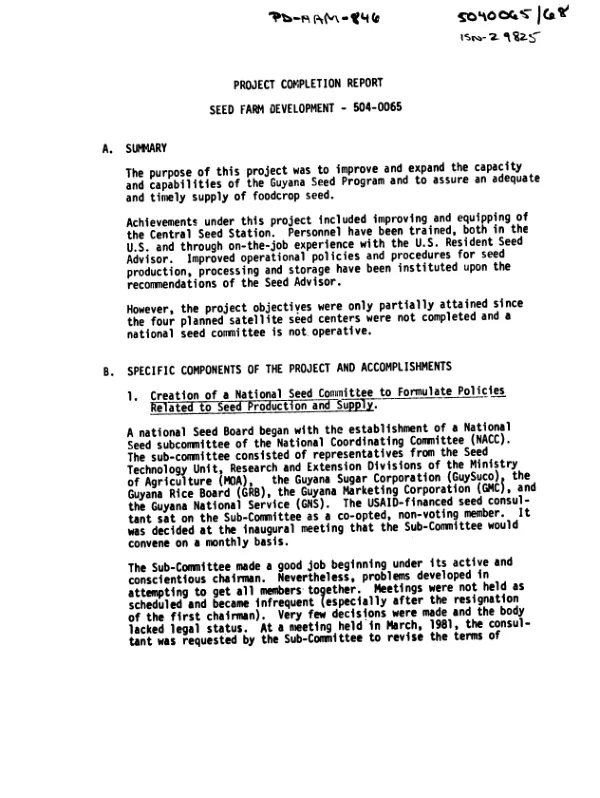
Provides final Mission report (dated 3/83) on a project to help the Government of Guyana and its Ministry of Agriculture (MOA) improve and expand the capabilities of the Guyana Seed Program.
1983
Sign in to readA free account is required to download.
Abstract
Some, but not all, project objectives were achieved. The seed conditioning unit, quality control laboratory, and storage room at the central agricultural station at Mon Repos were upgraded, and a corn elevator, portable sprinkler irrigation system, and seed treater were provided. The laboratory is now the best equipped in the Caribbean, and seed testing is carried out on a regular basis. The sprinkler system permits irrigation for seed production of some 10 acres during dry periods. In addition, improved operational policies and procedures for seed production, processing, and storage were instituted; U.S. seed technology training was provided to two M.S. candidates (the second due to complete training in 5/83); short-term U.S. training was provided to one laboratory technician, and a 3-week in-country training course provided to 17 seed workers. However, none of four planned seed satellite centers were constructed due to: a 6-month delay in technical assistance input because of contract approval delays; lack of MOA design expertise and failure of the MOA to request timely assistance; misunderstandings concerning construction plans; inflated construction costs; and failure to supply electric power at two sites. In addition, the National Seed Subcommittee, to be responsible for formulating seed production/supply policies, is not operational. The Subcommittee was established and made a good beginning, but following the resignation of its first chairman and unsuccessful attempts at legalization, no meetings have been held. Lessons learned are: due to poor coordination between the MOA and other agencies, delegation of authority to lower levels was insufficient; whenever equipment is ordered, spare parts should also be ordered; construction of satellite centers should have been spread over a longer period with high-priority centers receiving initial attention; farmers should be encouraged to participate in seed research and evaluations and contracted to grow certified seed; and provision of free or heavily subsidized seed creates disincentives to invest in a seed program.
Related documents