USAID DEC
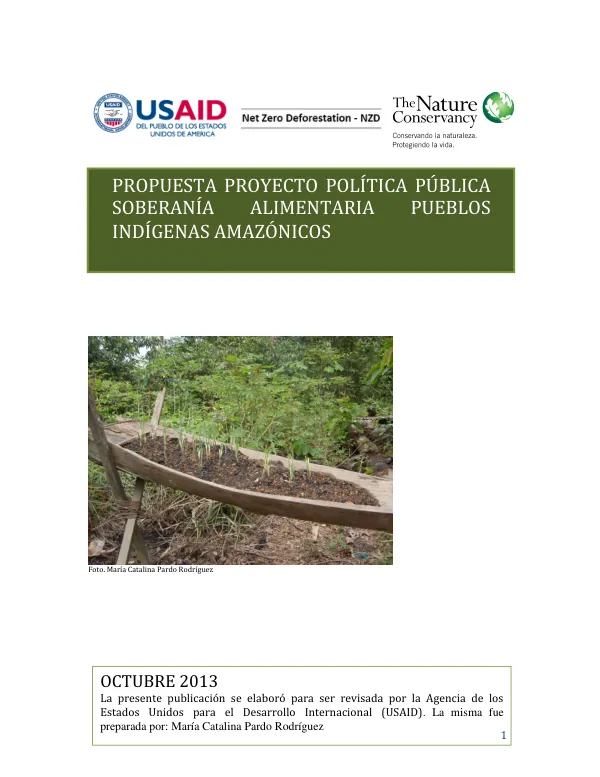
Propuesta Proyecto Política Pública Soberanía Alimentaria Pueblos Indígenas Amazónicos
Sign inAMAZON CONSERVATION TEAM
Propuesta Proyecto Política Pública Soberanía Alimentaria Pueblos Indígenas Amazónicos
The proposal for the project of formulation of public policy on food security and sovereignty of the indigenous peoples of the Amazonian region in Colombia aims to construct a participatory, concerted, and consulted policy with the indigenous peoples of the region.
2013 · 38 pages
Sign in to readA free account is required to download.
Abstract
The objective is to provide guidelines for public policy on autonomy and food security, oriented towards contributing to the food sovereignty of the indigenous peoples of the Amazonian region in Colombia and regional food security, as well as providing foundations for food sovereignty for the country. The construction of a public policy on autonomy and food security of the indigenous peoples must start with the strengthening of the indigenous chagra, which is conceived as a space of cultural, environmental, and agrobiodiversity reproduction, contributing elements to national sovereignty, as well as a complete cultural and territorial strengthening that respects the autonomy of the peoples. This requires a broad process of participation and consensus, understanding the current reality of the indigenous peoples within the regional context, their food circuits, their exchange relationships, and the state of the agroecosystems, among others. The proposal distinguishes between the concepts of security, autonomy, and sovereignty in the context of food security. Security food refers to the availability, physical and economic access to food, quality, safety, cultural identity, and effective nutrition. Autonomy food refers to the integral control of the food cycle, starting from the production and reproduction of seeds, availability and use of land, sustainable, public, and common water management, and control of one's own territory. Sovereignty food is when all these elements (security and autonomy) are guaranteed. The proposal establishes a differentiation between the concepts of security, autonomy, and sovereignty in the context of food security, highlighting the importance of considering the particularities of indigenous populations and their local management of forests, agricultural production dynamics, seasonal consumption patterns, and the complexity of local management of agricultural diversity. The proposal aims to establish a policy that prioritizes the autonomy and sovereignty of the indigenous peoples, recognizing their rights to their territories, cultures, and traditional practices. The policy should be based on a participatory and consultative process with the indigenous peoples, taking into account their knowledge, experiences, and perspectives. The proposal also highlights the importance of considering the global context of food security, including the impact of climate change, population growth, and the increasing demand for food. However, it emphasizes the need to prioritize the autonomy and sovereignty of the indigenous peoples, rather than relying on external solutions or technologies that may compromise their rights and interests. The proposal suggests a two-stage approach to developing the policy, with an initial stage of information collection and articulation, followed by a second stage of workshops and field diagnoses to gather local data and develop strategies and programs that are tailored to the specific needs and contexts of the indigenous peoples. The proposal also emphasizes the importance of establishing a clear understanding of the concepts of security, autonomy, and sovereignty in the context of food security, and of developing a policy that is based on a comprehensive and inclusive approach that takes into account the rights and interests of all stakeholders, including the indigenous peoples, governments, and international organizations. In conclusion, the proposal for the project of formulation of public policy on food security and sovereignty of the indigenous peoples of the Amazonian region in Colombia aims to construct a participatory, concerted, and consulted policy that prioritizes the autonomy and sovereignty of the indigenous peoples, recognizing their rights to their territories, cultures, and traditional practices. The policy should be based on a comprehensive and inclusive approach that takes into account the rights and interests of all stakeholders, and should prioritize the autonomy and sovereignty of the indigenous peoples in the context of food security.
Related documents
Documents in this collection
 2013
2013USAID DEC
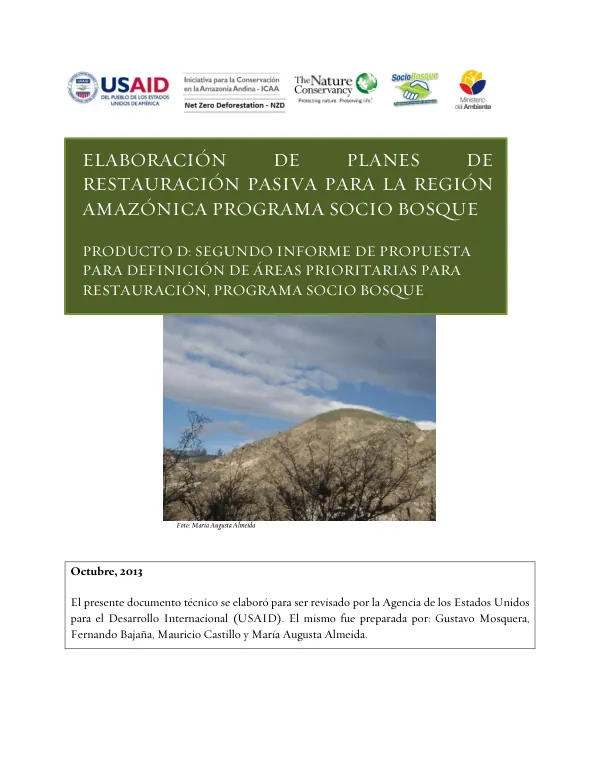
Segundo Informe de Propuesta para Definición de Áreas Prioritarias para Restauración, Programa Socio Bosque
Open record 2013
2013USAID DEC