USAID DEC
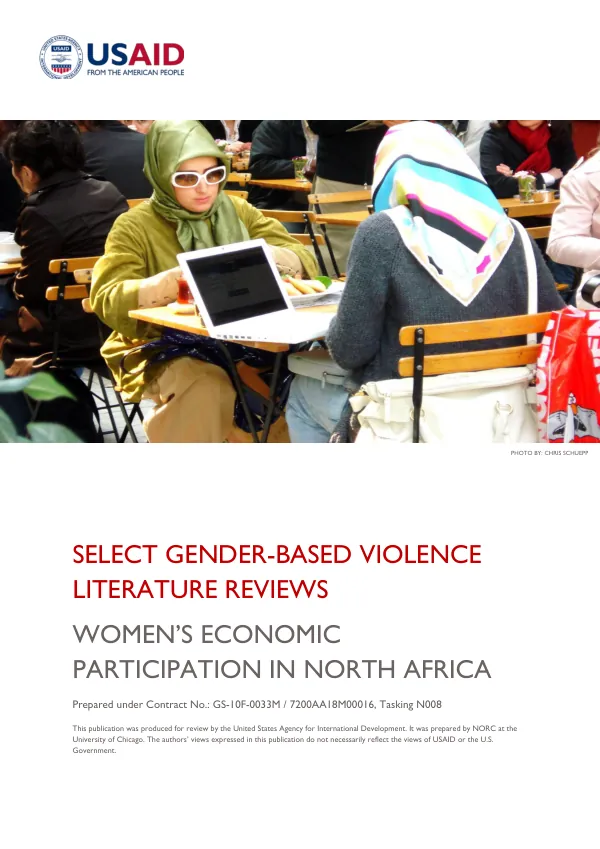
Select Gender-Based Violence Literature Reviews: Barriers to Women’s Political Participation in North Africa
Sign inNORC AT THE UNIVERSITY OF CHICAGO
Select Gender-Based Violence Literature Reviews: Barriers to Women’s Political Participation in North Africa
Women's political participation in the Middle East and North Africa (MENA) region remains limited, despite advancements in reform following the Arab Spring.
2020 · 35 pages
Sign in to readA free account is required to download.
Abstract
The barriers to women's political participation in the MENA region exist at the individual, household, community, and structural levels. Conflict and instability, such as in Libya, threaten women's security, while the COVID-19 pandemic has exacerbated existing inequities in women's access to income, education, and healthcare. Enduring norms that uphold male supremacy in the political, social, and economic sphere also present challenges for women's political participation. In North Africa, women are largely excluded from important political processes, such as constitution-building, political transitions, and peace negotiations. For example, in Libya, women are conspicuously absent from the country's peace process, despite their historical roles in politics and conflict resolution. Women's exclusion is attributed to normative and social structures that reinforce gendered roles, biases, and stereotypes that discriminate against women. Attitudes in the MENA region towards women in politics and political participation are illustrative of this exclusion issue. While most people in the region say they are receptive to women playing a role in politics, public opinion in North Africa appears to question women's capacity to do so. The use of parliamentary quotas for women is a popular strategy used to bolster women's political participation and representation in the MENA region. Libya, Morocco, Tunisia, and Algeria all have quotas that have contributed to the expansion of women's participation in national legislatures, increasing the number of women politicians and improving representation of women. However, gender gaps persist in these and other influential institutions, as well as in women's voting and political party affiliation. There is a paucity of evidence-based research examining the impact of interventions and approaches designed to address women's political participation in the MENA region. The lack of rigorous evaluation and studies exploring the impact of interventions addressing women's political participation is a global issue, not limited to the MENA region. More rigorous research and evaluation are needed to comprehensively understand the link between changes in women's political participation and various factors. The literature review highlights the importance of addressing the root causes of women's exclusion from politics, including persistent inequities in women's access to income, education, and healthcare, as well as enduring norms that uphold male supremacy. It also emphasizes the need for more rigorous research and evaluation to understand the impact of interventions and approaches designed to address women's political participation in the MENA region. The review provides recommendations for policymakers and practitioners seeking to advance women's political empowerment in the MENA region. The use of parliamentary quotas for women has been a popular strategy to bolster women's political participation and representation in the MENA region. Libya, Morocco, Tunisia, and Algeria all have quotas that have contributed to the expansion of women's participation in national legislatures. However, gender gaps persist in these and other influential institutions, as well as in women's voting and political party affiliation. The literature review highlights the need for more rigorous research and evaluation to understand the impact of interventions and approaches designed to address women's political participation in the MENA region. The COVID-19 pandemic has exacerbated existing inequities in women's access to income, education, and healthcare in the MENA region. Women's exclusion from politics and decision-making processes has been further exacerbated by the pandemic, highlighting the need for more inclusive and equitable policies and practices. The literature review emphasizes the importance of addressing the root causes of women's exclusion from politics, including persistent inequities in women's access to income, education, and healthcare, as well as enduring norms that uphold male supremacy. The literature review provides recommendations for policymakers and practitioners seeking to advance women's political empowerment in the MENA region. These recommendations include the use of parliamentary quotas for women, addressing laws and policies related to women's status, including men and boys in interventions, and capacity building that supports political women aided by quotas. The review also emphasizes the need for more rigorous research and evaluation to understand the impact of interventions and approaches designed to address women's political participation in the MENA region.