USAID DEC
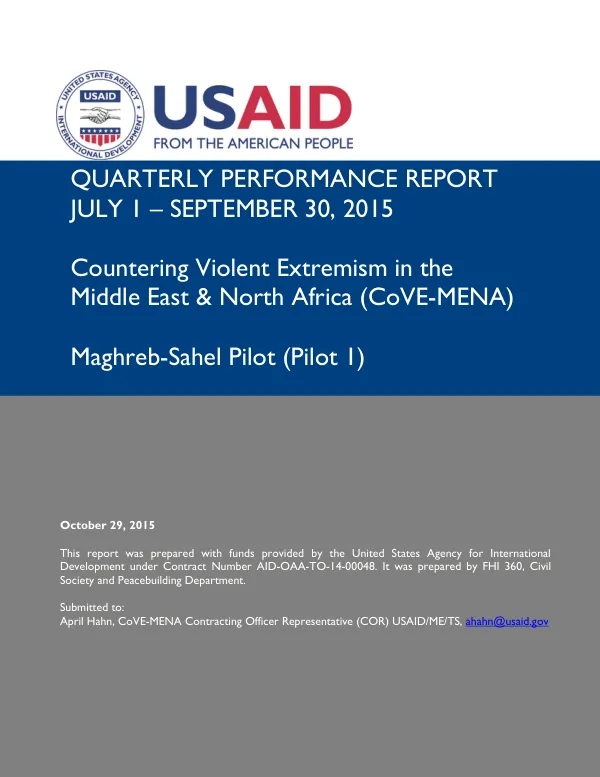
FHI 360 CoVE-MENA Maghreb – Sahel CSO Pilot Quarterly Performance Report (July 1 – September 30, 2015)
Sign inFHI 360
FHI 360 CoVE-MENA Maghreb – Sahel CSO Pilot Quarterly Performance Report (July 1 – September 30, 2015)
The Maghreb-Sahel CSO pilot, a project under the Countering Violent Extremism in the Middle East and North Africa (CoVE-MENA) Task Order, aims to facilitate cross-border countering violent extremism (CVE) exchanges, networking, and capacity building among civil society stakeholders.
2015 · 22 pages
Sign in to readA free account is required to download.
Abstract
Launched in July 2015, the pilot brought together representatives of civil society organizations (CSOs) from across the region in a four-day workshop that formed the basis for a regional community of practice (CoP) around CVE. The pilot focuses on supporting CSOs to collaborate, network, and build their capacity on CVE through the CoP, an in-kind grants (IKG) program, and a follow-on Lessons Learned workshop. The pilot activities are implemented in six countries: Algeria, Libya, Mali, Morocco, Niger, and Tunisia. The threat of violent extremism varies across these countries, but remains relatively low and dispersed overall, except in countries and areas where violent extremist organizations (VEOs) currently exist and/or operate. During the first regional workshop, participants discussed the situation within their different countries and identified the major push and pull factors that render youth vulnerable to violent extremism in their country contexts. The two main variables identified were the current level of active conflict in each country and the feasibility and accessibility of joining VEOs. The most salient push factors identified by the majority of country teams were political, including frustration over corruption, inefficient bureaucracy, poor or no service delivery, ethnic and/or tribal marginalization, and a lack of trust in political actors. In terms of pull factors, the groups largely agreed that social media as a medium was increasingly effective, but personal networks (mostly friends) remained important. The messages used to recruit individuals fall into two general categories: a distortion of religious ideological teachings and a narrative of spiritual fulfillment, and messaging that capitalizes on feelings of frustration, marginalization, and/or anti-Western sentiment. The findings from the first regional workshop suggest that ideology or pseudo-religious narratives are compelling insofar as they provide answers to the more primary vulnerabilities: lack of social cohesion, shared identity, and belonging. The pilot has made significant progress in its first quarter, with the planning and implementation of the first activity, the Participatory & Collaborative Approaches to CVE: Maghreb & Sahel Regional Workshop, in Casablanca, Morocco. The workshop brought together representatives of CSOs from across the region and formed the basis for a regional CoP around CVE. The pilot has also launched an online CoP for the workshop participants. The next quarter will focus on supporting CSOs to collaborate, network, and build their capacity on CVE through the CoP, IKG program, and a follow-on Lessons Learned workshop.
Related documents