USAID DEC
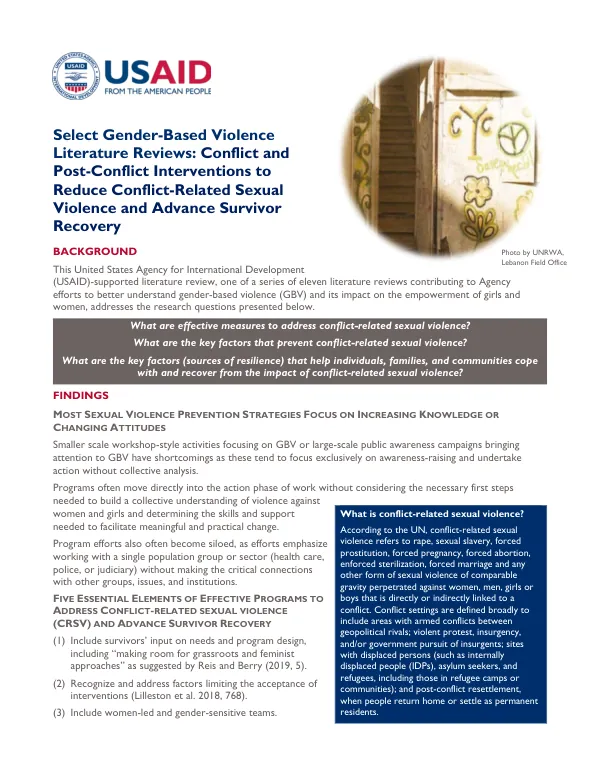
Select Gender-Based Violence Literature Reviews: Conflict and Post-Conflict Interventions to Reduce Conflict-Related Sexual Violence and Advance Survivor Recovery
Sign inUSAID DEC
Select Gender-Based Violence Literature Reviews: Conflict and Post-Conflict Interventions to Reduce Conflict-Related Sexual Violence and Advance Survivor Recovery
Conflict-related sexual violence (CRSV) refers to rape, sexual slavery, forced prostitution, forced pregnancy, forced abortion, enforced sterilization, forced marriage, and any other form of sexual violence of comparable gravity perpetrated against women, men, girls, or boys that is directly or indirectly linked to a conflict.
2021 · 2 pages
Sign in to readA free account is required to download.
Abstract
Conflict settings are defined broadly to include areas with armed conflicts between geopolitical rivals, violent protest, insurgency, and/or government pursuit of insurgents, sites with displaced persons, and post-conflict resettlement. Most sexual violence prevention strategies focus on increasing knowledge or changing attitudes. Smaller scale workshop-style activities and large-scale public awareness campaigns have shortcomings as they tend to focus exclusively on awareness-raising and undertake action without collective analysis. Programs often move directly into the action phase of work without considering the necessary first steps needed to build a collective understanding of violence against women and girls and determining the skills and support needed to facilitate meaningful and practical change. Program efforts also often become siloed, as efforts emphasize working with a single population group or sector without making the critical connections with other groups, issues, and institutions. Effective programs to address CRSV and advance survivor recovery include five essential elements. First, programs should include survivors' input on needs and program design, making room for grassroots and feminist approaches. Second, programs should recognize and address factors limiting the acceptance of interventions. Third, programs should include women-led and gender-sensitive teams. Fourth, programs should employ trained, skilled staff, including social workers, who are accountable, have a social-justice orientation, protect confidentiality, and uphold international standards for GBV service delivery. Fifth, programs should ensure implementers and staff recognize communities must acclimate to new initiatives designed to bring about change and build working relationships with other organizations whose efforts complement anti-GBV work. Designing programs that are theoretically grounded is essential. Such programs take into account not only practical examples that have worked in a number of settings but also are built upon frameworks that have been tested in the social science or behavioral health literature. Recruiting skilled staff who adhere to international standards for GBV service delivery and address CRSV with a social-justice orientation is also crucial. Staff should take a holistic perspective, assess community readiness for activities, build trust, and ensure confidentiality. Displacement can create opportunities for different stakeholders through social transformation, and women's lives can change positively through assuming new roles and responsibilities and attaining access and control over resources and decision making. Policymakers, civil society, and religious and cultural institutions need to appreciate women's new positions as household heads, primary earners, and single mothers in post-conflict settings and recognize and respect their agency and confront patriarchal structures at household and community levels.