USAID DEC
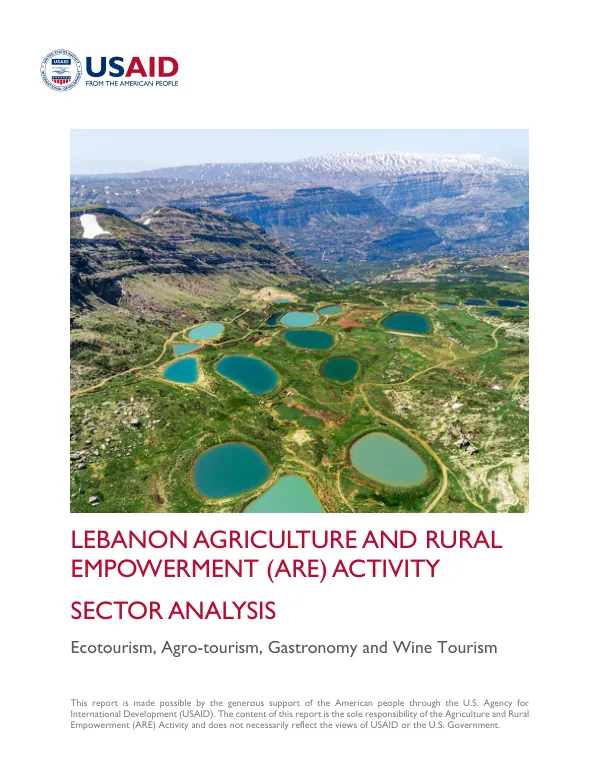
Lebanon Agriculture and Rural Empowerment (ARE) Activity Sector Analysis – Tourism
The Lebanon Agriculture and Rural Empowerment (ARE) Activity aims to develop rural economies in Lebanon through providing support to the agri-food sector and other industries to unlock local and export sales' potential, while also creating jobs and increasing farmers' and workers' incomes.
2021 · 88 pages
Sign in to readA free account is required to download.
Abstract
The prioritized agriculture and non-agriculture value chains that ARE targets include: fresh and processed produce; dairy and fodder; stone fruits; table grapes; wine and arak; ecotourism; agro-tourism; and gastronomy and wine tourism. The tourism sector in Lebanon is highly dependent on political stability and security. In 2019, Lebanon's tourism sector generated a total of $10.5 billion – 18% of the Gross Domestic Product (GDP) – and employed a direct and indirect workforce of 434,000 employees (19.2% of the total employment). However, the combined crises facing Lebanon since October 2019 — the economic and financial collapse, and the COVID-19 pandemic — had a severe impact on tourism, resulting in a 77% decrease in international arrivals in the first five months of 2020, compared to the same period in 2019. The major challenges and constraints hindering tourism development in Lebanon, particularly rural and nature-based tourism, include weak value chain integration and stakeholders' fragmentation, absence of specific legal framework, absence of categorization, quality control, and certification for niche markets, limited skilled labor pool and brain drain, absence of Destination Management Organizations (DMOs) on the local/regional level, lack of data, market information and absence of tourism satellite accounts, and absence of a national tourism brand and targeted international promotion strategy. Based on the sector value chain and business enabling environmental analysis, a set of opportunities and areas of intervention were identified to support the recovery, stabilization, and growth of ecotourism, adventure tourism, agro-tourism, gastronomy and wine tourism. These include valorizing the natural and cultural heritage and development of thematic tourism itineraries and routes, assisting/accompanying tourism business associations and selected tourism firms in building/improving their resilience towards crises and shocks, linking conventional tourism service providers (large scale) to alternative tourism service providers, building regional clusters regrouping key tourism service providers and creating territorial brands, creating an innovative and flexible destination brand for Lebanon based on the new global trends, investing in digital marketing and promotion and building brand awareness on the tourism e-marketplace, and categorizing, standardizing and certifying rural and nature-based tourism services and activities. The ARE Activity utilizes a facilitative approach based on the theory of market systems, which aims to create an enabling environment for the private sector to drive growth and development. The Activity targets the prioritized value chains, including ecotourism, agro-tourism, and gastronomy and wine tourism, to unlock local and export sales' potential, create jobs, and increase farmers' and workers' incomes. The report presents findings from a rapid analysis on the current situation of Lebanon's ecotourism, adventure tourism, agro-tourism, gastronomy and wine tourism sectors. It lays out their challenges/constraints, and the potential opportunities/interventions for the Lebanon Agriculture and Rural Empowerment (ARE) Activity in order to contribute to the recovery, stabilization, and growth of these tourism types. The analysis employed desk research and interviews with relevant stakeholders. The report highlights the importance of addressing the challenges and constraints hindering tourism development in Lebanon, particularly rural and nature-based tourism. It also emphasizes the need to create an enabling environment for the private sector to drive growth and development, and to unlock local and export sales' potential, create jobs, and increase farmers' and workers' incomes.