USAID DEC
Select Gender-Based Violence Literature Reviews: Engaging Faith and Community Leaders to End Child, Early and Forced Marriage
Sign inNORC AT THE UNIVERSITY OF CHICAGO
Select Gender-Based Violence Literature Reviews: Engaging Faith and Community Leaders to End Child, Early and Forced Marriage
Engaging faith and community leaders is a critical component in efforts to end child, early, and forced marriage (CEFM).
2021 · 2 pages
Sign in to readA free account is required to download.
Abstract
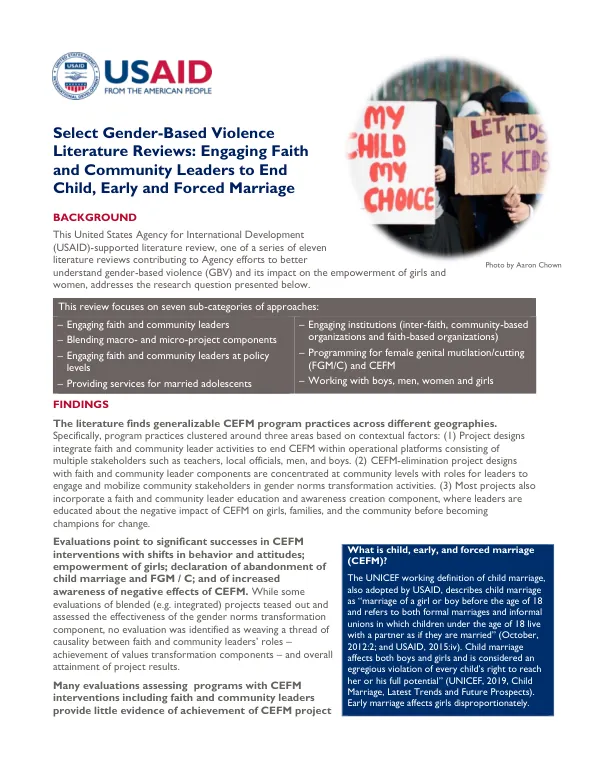
Research has identified generalizable program practices across different geographies, which cluster around three areas based on contextual factors. First, project designs integrate faith and community leader activities to end CEFM within operational platforms consisting of multiple stakeholders such as teachers, local officials, men, and boys. Second, CEFM-elimination project designs with faith and community leader components are concentrated at community levels, with roles for leaders to engage and mobilize community stakeholders in gender norms transformation activities. Third, most projects incorporate a faith and community leader education and awareness creation component, where leaders are educated about the negative impact of CEFM on girls, families, and the community before becoming champions for change. Evaluations of CEFM interventions have pointed to significant successes, including shifts in behavior and attitudes, empowerment of girls, declaration of abandonment of child marriage and FGM/C, and increased awareness of the negative effects of CEFM. However, the causal link between faith and community leader involvement and project outcomes appears tenuous, with some evaluations neglecting to isolate the impacts of leader components. Despite this, engaging faith and community leaders in shifting gender norms tends to achieve some aspects of aggregate project outcomes. Religious and traditional leaders taking a public stand against CEFM can mobilize communities, raise awareness, demonstrate alternative paradigms, catalyze resilience, and prompt community action to protect girls. Educating these actors with theological and health information can achieve attitudinal change, addressing misinformation and technical knowledge gaps. Effective CEFM projects draw from both sources, incorporating theological education focusing on religious tenets and justifications, as well as health education addressing technical knowledge gaps. The literature review highlights the importance of tracking gender norms transformation processes that faith and community leaders undergo, predicting their sustainability, and formulating integrated indicators to track blended project components. It also emphasizes the need to develop new models to explore the interoperability between micro- and macro-project components and test the extent to which multi-component projects are indeed blended. Furthermore, future studies must seek to align faith and community leader roles along an expected curve of girls' ups and downs as they struggle for true empowerment. Mainstreaming faith and community leader indicators and variables is also recommended, with an immediate starting point being to mainstream faith and community leader-related intermediate variables within the 147 key indicators for tracking the performance of CEFM interventions developed by USAID.
Related documents