USAID. MISSION TO BOLIVIA
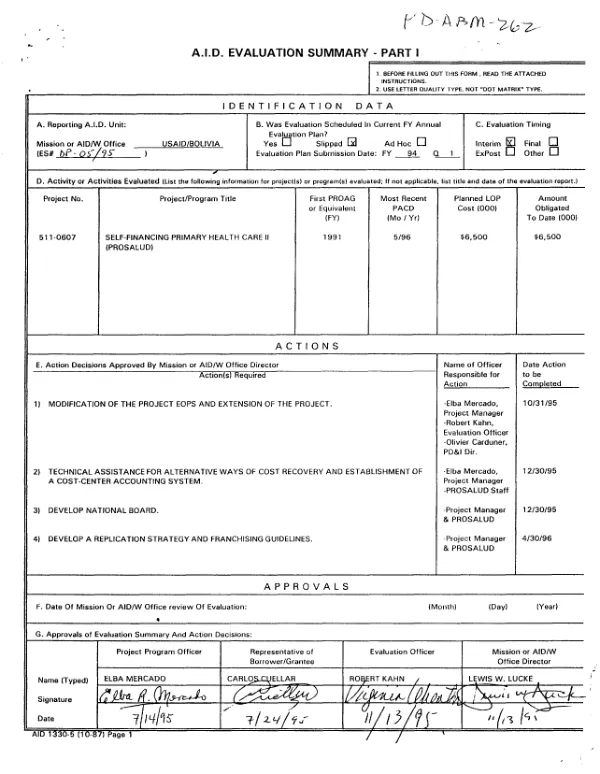
Self-financing primary health care II (PROSALUD)
Summarizes mid-term evaluation of a project to assist PROSALUD, a Bolivian private health care provider, in replicating its Santa Cruz-based primary health care (PHC) program in the cities of El Alto and La Paz while strengthening its program in Santa Cruz.
1995
Sign in to readA free account is required to download.
Abstract
The evaluation covers the period 1991-3/95. PROSALUD is a patient-focused, maternal/child health care (MCH)-centered delivery system distinguished by its ability to provide a high volume of quality services with high levels of efficiency, cost recovery, and patient satisfaction. The program relies on open, well-documented, and institutionalized management systems which foster data-based decisionmaking, planning, and monitoring. Its personnel system promotes the hiring of staff dedicated to supportive patient relations leading to high continuity in care. The Santa Cruz delivery model has been successfully replicated in El Alto La Paz, and as of 5/95 about 60% of cost recuperation, less the cost of the Management Support Unit (MSU), has been achieved. The planned level of service has not been reached due to a delay in acquiring the service facilities from collaborating donors. Therefore, it is not likely that the project will achieve the goal of 100% self-financing, exclusive of the MSU in La Paz and inclusive of the MSU in Santa Cruz, by the 5/96 PACD. The End of Project Status (EOPS) indicators appear to be flawed. The degree of self-financing should not be the single yardstick used to assess PROSALUD"s performance. PROSALUD is a major provider of health services in its own right, serving, for example, 95% of the new users of family planning in 1993 in the El Alto/La Paz health districts, and is more MCH-oriented in terms of reaching children under age 5 than other providers, including the National Secretariat of Health. In addition, the presence of PROSALUD has had a noticeable indirect benefit equal to the stated direct objectives of the project. In El Alto, the project"s presence has caused a reduction of private provider charges for the same services and has motivated providers to improve services to avoid losing market share. Lessons learned include the following. (1) Inputs essential for achieving project goals need to be made part of the funding package. When inputs for clinic construction depend on other entities (as in this project), an alternative strategy for acquiring these inputs needs to be written into the Project Paper in case collaborating institutions fail to participate as planned. (2) Selection of project sites should be commensurate with project objectives. The selection of El Alto, one of the poorest communities in Bolivia, as the principal PHC site, jeopardizes the cost recovery goal of the project. (3) Projects need to give attention to and be prepared to document the indirect benefits of their activities which, as in the case of this project, can be as great as the planned direct effects. (Author abstract, modified)
Related documents