URBAN INSTITUTE (UI)
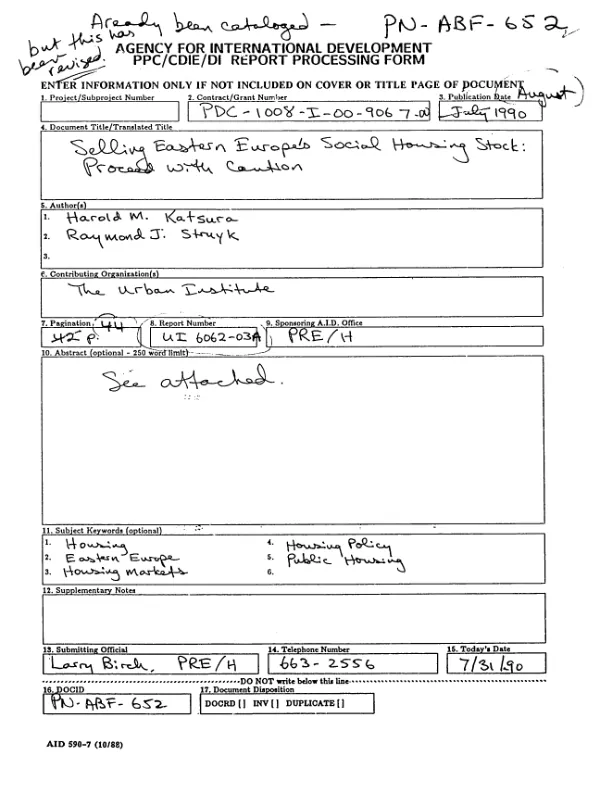
Selling Eastern Europe"s social housing stock : proceed with caution
In the centrally planned economies of Eastern Europe, a large share of the housing stock, particularly in urban areas, is state-owned and often rented at nominal amounts.
Katsura, Harold M.; Struyk, Raymond J. · 1990
Sign in to readA free account is required to download.
Abstract
Worsening economic conditions in these countries have generated interest in privatizing the social housing sector in order to reduce budgetary outlays for construction, operation, and maintenance. This paper helps determine the feasibility of such privatization by reviewing the experiences of three countries -- China, Hungary, and the United Kingdom -- that have already tried to sell state-owned housing to their citizens. The programs are assessed in terms of their success in encouraging sales by: raising rents, rationalizing borrowing terms, clarifying and strengthening property rights, and stimulating the demand to hold housing as an asset. While the United Kingdom has had some success, sales have been poor in China and Hungary because of confused property rights and strong tenant protections. In all cases, purchasers have paid far less than the market price. A final section considers actions that should accompany the privatization of state rental stock (protecting the poorest families in the necessary process of raising rents, providing market rate financing for the purchasing of units, and privatizing the management of properties), stresses the broader goals of privatization (housing market equity and efficiency), and offers insights for avoiding a misguided privatization effort, such as would occur, for example, if units were sold at such low prices and with such heavily subsidized loans that the sales actually resulted in an additional drain on government finance.
Related documents