USAID DEC
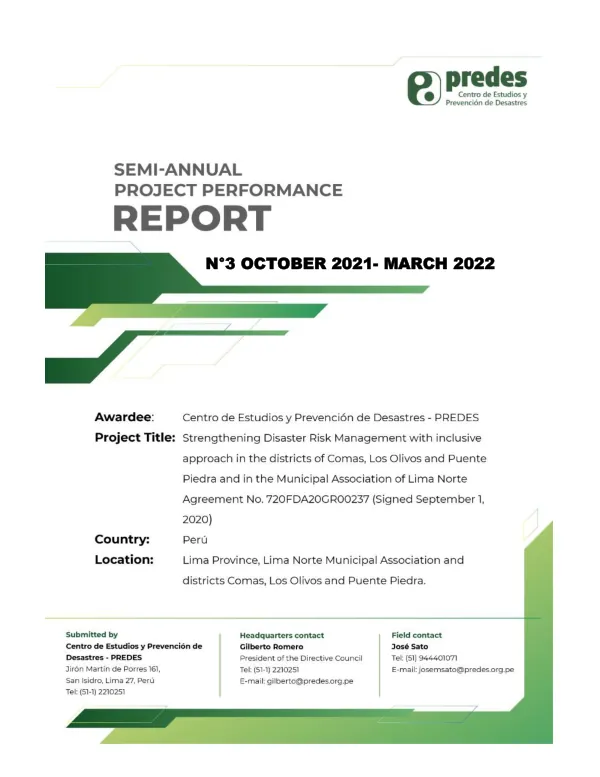
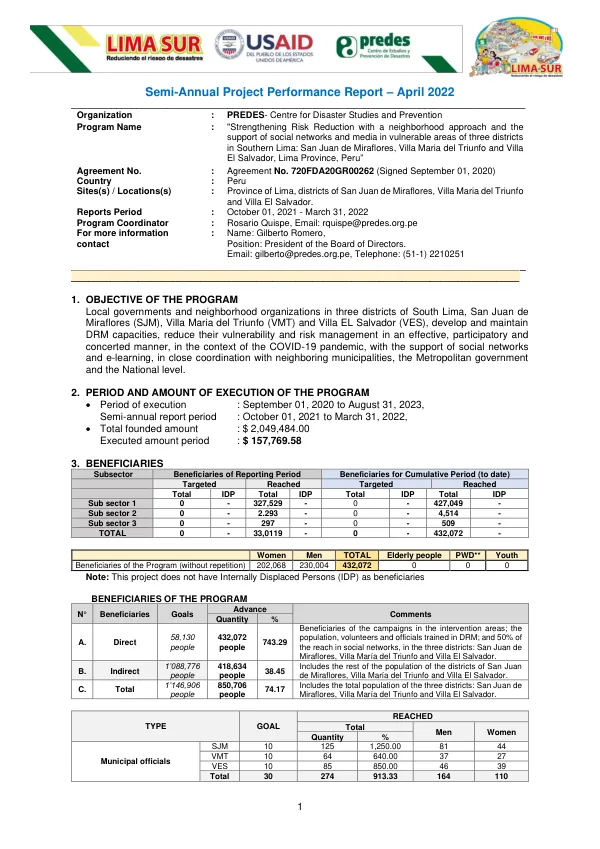
Semi-Annual Project Performance Report – April 2022
The program "Strengthening Risk Reduction with a Neighborhood Approach and the Support of Social Networks and Media in Vulnerable Areas of Three Districts in Southern Lima" aims to develop and maintain Disaster Risk Management (DRM) capacities in the districts of San Juan de Miraflores, Villa María del Triunfo, and Villa El Salvador.
2022 · 11 pages
Sign in to readA free account is required to download.
Abstract
The program focuses on building community awareness and mobilization, capacity building and training, and policy and planning. The program has achieved significant progress in building community awareness and mobilization, with a total of 427,049 people sensitized, which is 744.69% of the programmed goal. The communication strategy has been complemented with a consultancy for the Mapping of Media and Spaces of the Prioritized Districts of South Lima. The program has also established 44 WhatsApp groups, with a total of 1,908 people, to disseminate information on prevention against COVID-19 and DRM. Capacity building and training have been conducted, with a total of 4,393 people trained, which is 559.62% of the programmed goal. The program has also trained 121 people in emergencies and disasters, including 51 men and 70 women, in first aid, search and rescue, and disaster risk reduction related to health. Policy and planning have been implemented, with a total of 2 of the 14 approved programmed plans completed. The program has also conducted risk studies, with a total of 8 scheduled risk studies completed. The program has achieved significant progress in achieving its goals, with a total of 432,072 people reached, which is 743.29% of the programmed goal. The program has also established a strong communication strategy, with a total of 44 WhatsApp groups and 1,908 people. Recommendations have been made to improve the program's effectiveness, including implementing strategies for the collection of family emergency plans, applying questionnaires in all face-to-face events, and increasing the rebound of the project's messages through social networks and the website. The program has also faced challenges, including the need to adapt to the COVID-19 pandemic and the lack of internet access in some areas. The program has had to adjust its activities to accommodate these challenges, including conducting virtual activities and using social networks to disseminate information. Overall, the program has made significant progress in achieving its goals and has established a strong foundation for future success. The program's focus on building community awareness and mobilization, capacity building and training, and policy and planning has been effective in achieving its objectives. The program's achievements include: * 427,049 people sensitized, which is 744.69% of the programmed goal * 4,393 people trained, which is 559.62% of the programmed goal * 121 people trained in emergencies and disasters * 2 of the 14 approved programmed plans completed * 8 scheduled risk studies completed * 44 WhatsApp groups established, with a total of 1,908 people The program's challenges include: * Adapting to the COVID-19 pandemic * Lack of internet access in some areas * Need to adjust activities to accommodate these challenges The program's recommendations include: * Implementing strategies for the collection of family emergency plans * Applying questionnaires in all face-to-face events * Increasing the rebound of the project's messages through social networks and the website.
Related documents