THE NATURE CONSERVANCY
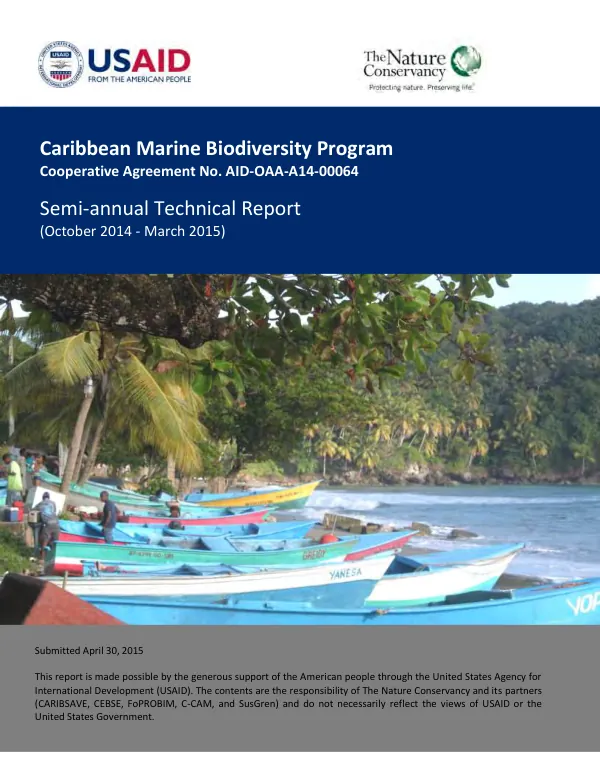
Semi-annual Technical Report: Caribbean Marine Biodiversity Program
The Caribbean Marine Biodiversity Program officially started on September 29, 2014, following the signature of the Cooperative Agreement No.
2015 · 20 pages
Sign in to readA free account is required to download.
Abstract
AID-OAA-A14-00064 between the United States Agency for International Development (USAID) and The Nature Conservancy. Initial start-up activities included completion of required USAID deliverables, such as the Year 1 Work Plan, Performance Management Plan, Branding and Marking Plan, and Environmental Monitoring and Mitigation Plan. These documents were submitted on time and approved by USAID. Recruitment of personnel was also a key aspect of the start-up phase. By January 2015, all TNC staff in the Program Management Unit (PMU) were successfully recruited, including the Chief of Party, Deputy Chief of Party, Program Coordinator, Grants Specialist, and Program Assistant. The PMU, responsible for all CMBP coordination and administrative issues, was fully operational by January 2015. Additionally, three Seascape Coordinators were recruited by March 2015 to cover the Dominican Republic, Grenada and St. Vincent and the Grenadines, and Haiti. Regional Inception Meeting and compliance training were also conducted in December 2014. An internal TNC compliance training was held, covering grants and contracts management related to federal funding and specific USAID regulations. This training was followed by a two-day CMBP Inception Meeting involving TNC staff and staff from the five other Consortium partners. The meeting objectives were accomplished, including increased understanding of the program design and activities, building of relationships and trust among partners, and refinement of the Year 1 Work Plan. The Caribbean Marine Biodiversity Program addresses direct and indirect threats to marine and coastal biodiversity at multiple geographic scales simultaneously. The program includes four major Expected Results: enabling environment created for long-term MMA success, effective marine spatial plans and seascape governance mechanisms, more sustainable fisheries sector, and effective management and governance of MMAs. The program is being implemented through a cooperative agreement between USAID and The Nature Conservancy, with activities carried out through a consortium of five local NGO sub-award partners. The program's geographic focus is on four targeted seascapes: North Coast of Hispaniola, Samaná Bay, Pedro Bank and Southwest Coast of Jamaica, and Grenadine Bank. The program's implementation is centered on these seascapes, with activities aimed at achieving the four Expected Results. The program's progress and major outputs are reported in the following sections. Expected Result #1: Enabling environment created for long-term MMA success. The program has made significant progress in creating an enabling environment for long-term MMA success. This includes the development of a set of required USAID deliverables, such as the Year 1 Work Plan and Performance Management Plan, which were submitted on time and approved by USAID. Expected Result #2: Effective marine spatial plans and seascape governance mechanisms. The program has made progress in developing effective marine spatial plans and seascape governance mechanisms. This includes the development of a Decision Support System (DSS) to support marine spatial planning and the establishment of a Committee for Environmental Protection of Caracol Bay (SEPROBAC) in Haiti. Expected Result #3: More sustainable fisheries sector. The program has made progress in promoting sustainable fisheries and sustainable livelihoods for fishers. This includes the development of a sustainable finance mechanism (e.g. tourism fees) and the promotion of innovative fishery management actions. Expected Result #4: Effective management and governance of MMAs. The program has made progress in effective management and governance of MMAs. This includes the development of a set of required USAID deliverables, such as the Year 1 Work Plan and Performance Management Plan, which were submitted on time and approved by USAID. The program has also faced challenges, including the need to build relationships and trust among Consortium partners and the need to refine the Year 1 Work Plan. However, the program has made significant progress in achieving its Expected Results and is on track to meet its objectives.