THE NATURE CONSERVANCY
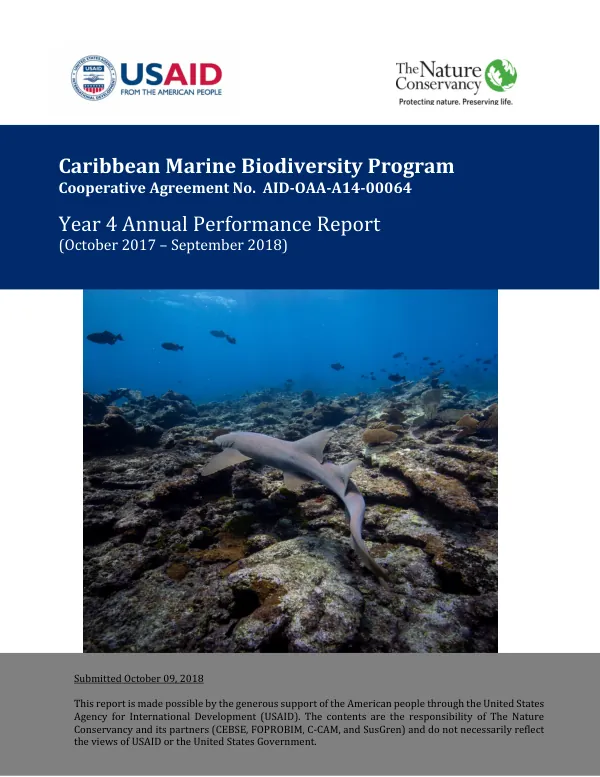
Year 4 Annual Performance Report: Caribbean Marine Biodiversity Program
The Caribbean Marine Biodiversity Program (CMBP) aims to reduce threats to marine-coastal biodiversity in priority areas in the Caribbean.
2018 · 102 pages
Sign in to readA free account is required to download.
Abstract
The program addresses direct and indirect threats to marine and coastal biodiversity at multiple geographic scales simultaneously. Four major Expected Results guide the program's activities: creating an enabling environment for long-term Marine Managed Area (MMA) success, effective marine spatial plans and seascape governance mechanisms, a more sustainable fisheries sector, and effective management and governance of MMAs. The program is being implemented through a cooperative agreement between the U.S. Agency for International Development (USAID) and The Nature Conservancy (TNC). Activities are being carried out through a consortium of local NGO sub-award partners, including the Caribbean Coastal Area Management Foundation (C-CAM), Center for Conservation and Eco-development of Samaná Bay and Its Surroundings (CEBSE), Foundation for the Protection of Marine Biodiversity (FOPROBIM), and Sustainable Grenadines Inc. (SusGren). In Year 4, the program made significant progress in achieving its Expected Results. At the regional level, CMBP organized a bi-national workshop with government authorities from the Dominican Republic and Haiti to discuss and finalize a binational action plan for sustainable fisheries management. The program also executed a regional outreach campaign to promote the non-harvesting, sale, and consumption of parrotfish, which play a crucial role in maintaining healthy coral reefs. In the Dominican Republic, the Caribbean Biodiversity Fund transferred $320,450 to Fondo MARENA, enabling the organization to issue its first call for proposals for grants to support marine resources conservation. Additionally, the Espiritu Santo Cooperative initiated its ecotourism operations, providing an alternative livelihood for local communities. In Haiti, the Protected Area of Three Bays (PA3B) was established, providing a safe haven for marine life and promoting sustainable livelihoods for local communities. The program also supported the development of a marine spatial plan for the North Coast of Hispaniola, which will guide the management of marine resources in the region. In Jamaica, the program supported the development of a marine spatial plan for the Pedro Bank and Southwest Coast of Jamaica, which will help to manage marine resources and promote sustainable livelihoods for local communities. The program also worked with the Government of Jamaica to develop a fishery sector action plan, which aims to promote sustainable fisheries management and reduce the impact of fishing on marine ecosystems. In Grenada and St. Vincent and the Grenadines, the program supported the development of a marine spatial plan for the Grenadine Bank, which will guide the management of marine resources in the region. The program also worked with local communities to develop sustainable livelihoods and promote eco-tourism in the area. Overall, the CMBP made significant progress in Year 4, achieving many of its Expected Results and laying the foundation for long-term success. The program's activities have helped to promote sustainable livelihoods, reduce the impact of fishing on marine ecosystems, and protect marine biodiversity in the Caribbean.