USAID. MISSION TO MALI
Semi-arid tropics research
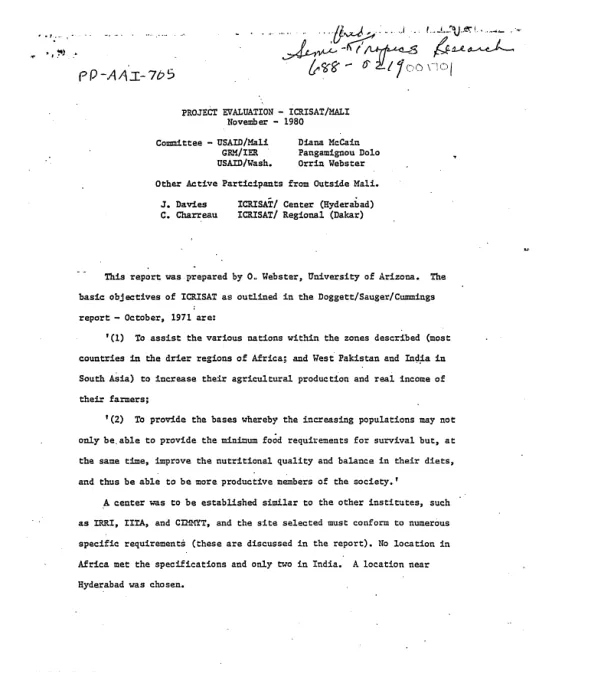
Evaluates project to develop and disseminate technical packages for improved grain varieties and to stengthen the agricultural research capacity in Mali.
Reddy, S.. K.; Scheuring, J. · 1984
Sign in to readA free account is required to download.
Abstract
PES covers the period 7/81-9/83 and is based on an attached special evaluation (XD-AAQ-402-A). Despite overly ambitious targets, this cost-effective project is well on schedule; the Mali model could prove to be one of the most viable of the African agricultural research and training approaches implemented by the International Crops Research Institute for the Semi-Arid Tropics. The sorghum and millet breeding component has conducted significant research on sorghum, millet, and pigeon pea varieties for a wide region in West Africa through research at the Cinzana semiarid research station (fully operational since 6/83) and more than 8 other sites. The agronomic component has assisted the breeding component and successfully experimented with sorghum, millet, and cowpea intercropping, technology management, cultural techniques (e.g., animal traction, weed control, and surface water management), and the use of organic and natural fertilizers; however, the planned 2-5 trials per year on forage production and watershed and fallow management have not been completed due to insufficient staffing. Although linkages among research stations, field trials, and crop production projects have been well established, farm-level data collection and technology transfer to farmers has been weak; a farming systems research project, set to begin shortly, should strengthen this linkage. Construction of the planned library is on schedule. Project assumptions have proven valid, except that: (1) sorghum and millet prices have been liberalized, which should have a positive effect on grain production; and (2) the assumption that varieties developed elsewhere can be transferred easily to Mali has proven unrealistic. The project has provided short-term training for 12 Malians in India on agronomic and plant breeding techniques and to technical specialists and junior scientists through on-the-job experiences. Four participants are attending or will soon leave for long-term U.S. degree programs; a fifth is studying in India. Recommendations include a possible 5-year project extension.