JOHN SNOW INTERNATIONAL
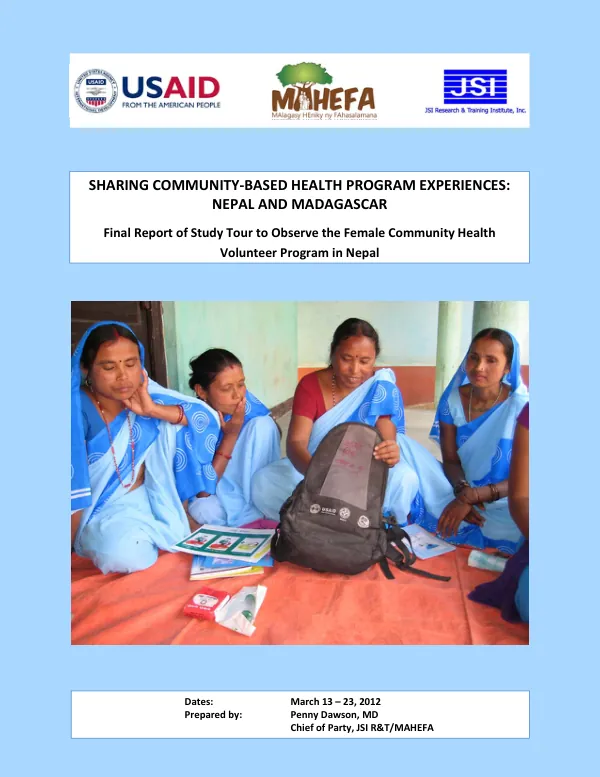
Sharing Community-Based Health Program Experiences: Nepal and Madagascar
The Female Community Health Volunteer Program in Nepal began in 1988 with the goal of providing essential health services to rural communities.
2012 · 40 pages
Sign in to readA free account is required to download.
Abstract
The program, which is an official initiative of the Ministry of Health and Population (MOHP)/Nepal, has expanded to cover all 75 districts of the country, with approximately 50,000 Female Community Health Volunteers (FCHVs) trained and supported to provide a wide range of services, including counseling, treatment, and referral services for various conditions and illnesses. The FCHV program has contributed significantly to Nepal's health indicators, with the country making steady progress towards achieving Millennium Development Goals (MDG) 4 and 5. The program has also been recognized for its potential to save lives through the provision of life-saving treatments and interventions at the community level. Several studies have documented the role of FCHVs in improving health outcomes in Nepal. The MOHP and external development partners (EDPs) involved in supporting the FCHV program in Nepal have explored various methods of providing incentives and support to FCHVs. These include a community-based fund, stipends for training, specific campaign days, the establishment of a National FCHV day, the preparation of a documentary about FCHVs, and community mobilization to recognize and support their volunteers. A study tour was conducted in 2012 to expose public health professionals from Madagascar to the successful FCHV program in Nepal. The tour provided an opportunity for the Malagasy team to learn from the experiences of Nepal and discuss successful programs with the MOHP, health facility, and EDP staff. The tour aimed to address the challenges faced by the community-based health program in Madagascar, including the standardized recruitment of community health workers and coordination between NGO partners and the Ministry of Health. The Human Development Index (HDI) for 2011 ranked Nepal 157 out of 187 countries, while Madagascar ranked 151. Despite similar GDP rankings, Nepal has better health indicators, which may be attributed to its strong community-based public health program. The FCHV program in Nepal has been recognized for its potential to improve health outcomes and contribute to the country's progress towards achieving MDG 4 and 5. The FCHV program in Nepal has been successful in providing essential health services to rural communities, contributing to improved health indicators, and saving lives through the provision of life-saving treatments and interventions. The program's success has been recognized globally, and it serves as a model for community-based health programs in other countries. The study tour to Nepal provided an opportunity for public health professionals from Madagascar to learn from the experiences of Nepal and discuss successful programs with the MOHP, health facility, and EDP staff. The FCHV program in Nepal has been supported by various partners, including the MOHP, EDPs, and NGOs. The program has received financial and logistical support from USAID and JSI, among others. The program's success has been documented through various studies and publications, which highlight the role of FCHVs in improving health outcomes in Nepal. The FCHV program in Nepal has been recognized for its potential to improve health outcomes and contribute to the country's progress towards achieving MDG 4 and 5. The program's success has been attributed to its strong community-based approach, which has enabled the provision of essential health services to rural communities. The program's model has been recognized globally, and it serves as a model for community-based health programs in other countries.
Related documents