MINISTRY OF HEALTH AND CHILD WELFARE
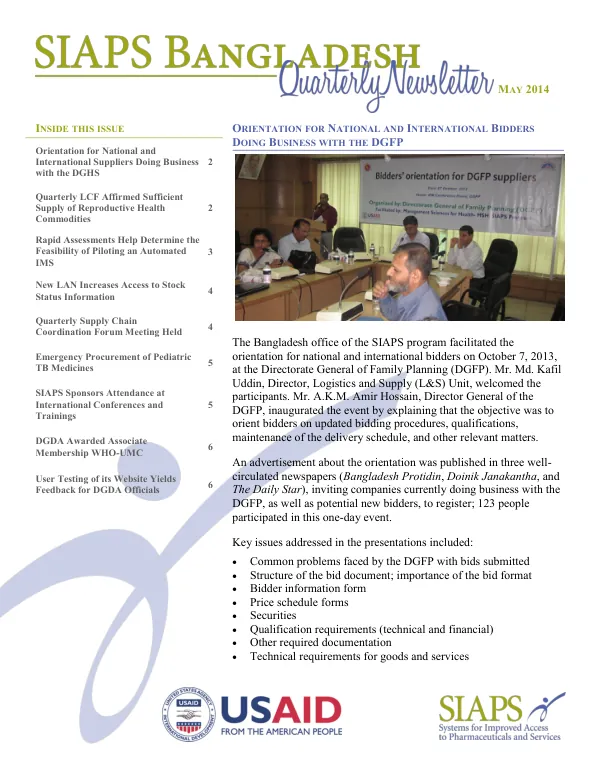
SIAPS Bangladesh Quarterly Newsletter, July 2015
The National Tuberculosis Control Program (NTP) of Bangladesh, in collaboration with the Systems for Improved Access to Pharmaceuticals and Services (SIAPS) Program, implemented a three-day training on forecasting and data-driven supply planning for tuberculosis (TB) medicines in March 2015.
2015 · 5 pages
Sign in to readA free account is required to download.
Abstract
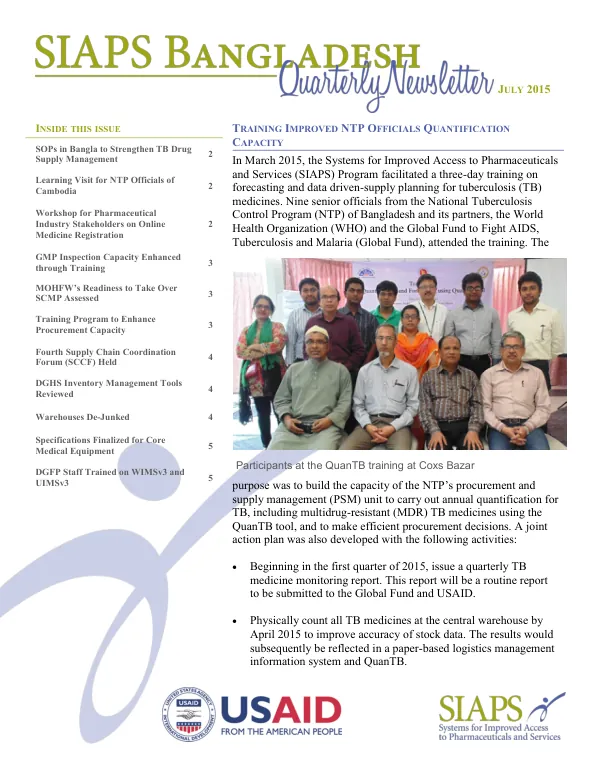
The training aimed to build the capacity of the NTP's procurement and supply management (PSM) unit to carry out annual quantification for TB, including multidrug-resistant (MDR) TB medicines using the QuanTB tool. Nine senior officials from the NTP and its partners, the World Health Organization (WHO) and the Global Fund to Fight AIDS, Tuberculosis and Malaria (Global Fund), attended the training. The training focused on developing a joint action plan to improve TB medicine supply management, including the issuance of a quarterly TB medicine monitoring report, physical counting of all TB medicines at the central warehouse, and the development of a paper-based logistics management information system and QuanTB. As part of the sustainability plan, the NTP identified two medical officers to work with the SIAPS technical team to gradually take over the responsibility of the quantification activity by the end of 2015. SIAPS also supported the NTP in updating, publishing, and circulating the second edition of standard operating procedures (SOPs) in English for TB drug supply management. To better manage TB drug supply across the country, SIAPS provided technical assistance to the NTP for translating the second edition of SOPs into Bangla and facilitated a workshop in February 2015 to finalize it. The workshop participants, including NTP officials and experts from NTP partner organizations, reviewed the draft document and made necessary modifications that were later incorporated into the final document. In addition, a seven-member team from the Cambodian National TB Control Program visited Bangladesh in March 2015 to observe the feasibility and functionality of e-TB Manager. The Cambodian NTP is planning to adopt e-TB Manager for their TB program, and the visit aimed to assist them in understanding how Bangladesh's NTP can better manage TB cases through e-TB Manager. The visitors, accompanied by officials from the Directorate General of Health Services (DGHS), NTP, and SIAPS, met with local government health authorities and learned about the onsite performance, data flow, validation procedures, and monitoring aspects of e-TB Manager. SIAPS also facilitated an awareness workshop on online medicine registration for pharmaceutical industry stakeholders in February 2015. The workshop aimed to create an environment for early engagement of pharmaceutical industry stakeholders and to orient them on PharmaDex and CTD-based dossiers. A total of 83 participants attended the workshop, including representatives from 40 pharmaceutical companies, DGDA officials, USAID representatives, and representatives from the Bangladesh Association of Pharmaceutical Industries (BAPI). The participants appreciated DGDA's initiative to introduce international standards for medicine registration and provided constructive feedback and suggestions for smooth implementation of the process. To continue improving DGDA's Good Manufacturing Practices (GMP) inspection processes, SIAPS set up a four-day training for DGDA's district-level inspectors in March 2015. The training focused on understanding the basics of GMP, inspection methodology, and techniques. Through an in-class practical exercise and case studies, DGDA inspectors learned to recognize fake and counterfeit medicines. Subsequent training includes site visits for DGDA inspectors to be walked through the steps of inspecting manufacturing facilities using standard tools of GMP inspection. SIAPS also supported the Engineering Staff College of Bangladesh (ESCB) to conduct basic training on public procurement management for 40 Government of Bangladesh officials this quarter. The training aimed to build the capacity of all procuring entities of the Ministry of Health and Family Welfare (MOHFW). As part of the long-term sustainability strategy, SIAPS continued advocacy with the MOHFW to completely hand over the Supply Chain Management Portal (SCMP) to MOHFW's Procurement and Logistics Management Cell (PLMC) by 2016. A consultative session to assess the Ministry's readiness was held on February 24, 2015, and major decisions were made to ensure a smooth transition of the SCMP to MOHFW/PLMC. The Fourth Supply Chain Coordination Forum (SCCF) was held in March 2015, bringing together stakeholders from the public and private sectors to discuss supply chain management issues and identify solutions. The forum aimed to improve supply chain coordination and management, and to enhance the availability of essential medicines in the country. The SCCF provided a platform for stakeholders to share their experiences, best practices, and lessons learned in supply chain management. SIAPS also reviewed the inventory management tools used by the Directorate General of Health Services (DGHS) and the Directorate General of Family Planning (DGFP). The review aimed to identify areas for improvement and to provide recommendations for enhancing inventory management practices. In addition, SIAPS de-junked warehouses and finalized specifications for core medical equipment. The Directorate General of Family Planning (DGFP) staff were trained on WIMSv3 and UIMSv3, which