USAID
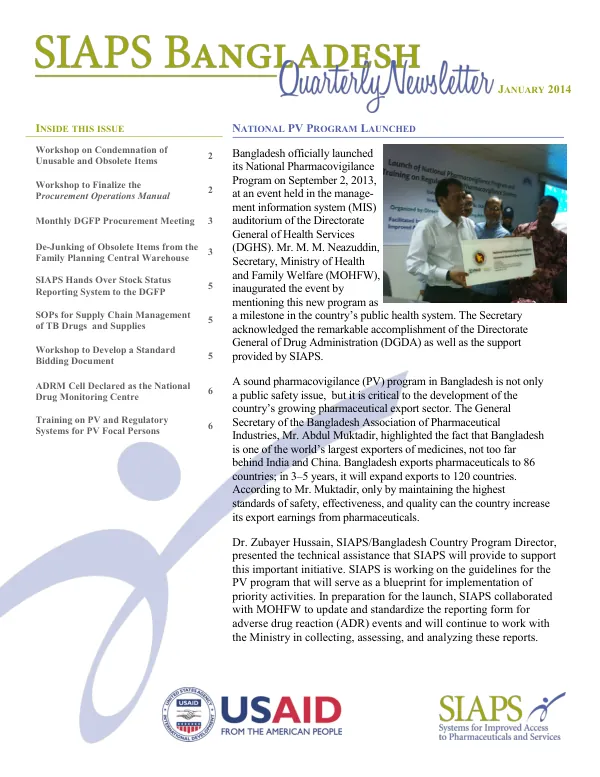
SIAPS Bangladesh Quarterly Newsletter
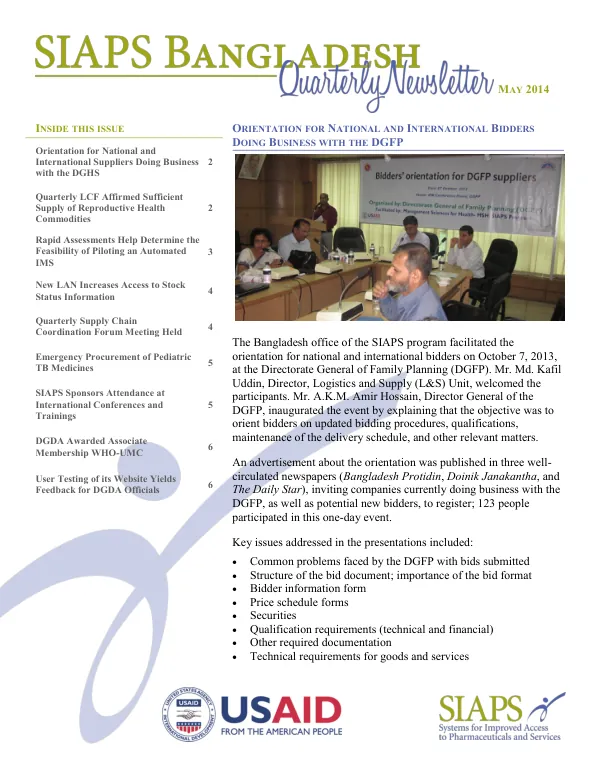
The Bangladesh office of the SIAPS program facilitated the orientation for national and international bidders on October 7, 2013, at the Directorate General of Family Planning (DGFP).
2014 · 7 pages
Sign in to readA free account is required to download.
Abstract
Mr. Md. Kafil Uddin, Director, Logistics and Supply (L&S) Unit, welcomed the participants. Mr. A.K.M. Amir Hossain, Director General of the DGFP, inaugurated the event by explaining that the objective was to orient bidders on updated bidding procedures, qualifications, maintenance of the delivery schedule, and other relevant matters. An advertisement about the orientation was published in three well-circulated newspapers, inviting companies currently doing business with the DGFP, as well as potential new bidders, to register; 123 people participated in this one-day event. Key issues addressed in the presentations included common problems faced by the DGFP with bids submitted, structure of the bid document, importance of the bid format, bidder information form, price schedule forms, securities, qualification requirements, and other required documentation. In the open discussion session, participants raised a number of questions to clarify the bidding process. Bidders offered some recommendations to strengthen the procurement procedure in the future, including expedited registration of commodities with the Directorate General of Drug Administration (DGDA) and automatic notification of unsuccessful bidders. The annual orientation for suppliers of the Central Medical Store (CMSD) of the Directorate General of Health Services (DGHS) was organized by SIAPS on November 12, 2013. The program was chaired by Brigadier General Syed Iftekhar Uddin, Director, CMSD. Suppliers of medical and non-medical commodities and CMSD procurement officials attended. The DG delivered the opening remarks and presentations were delivered by Dr. Akteruzzaman, Assistant Director (Procurement), CMSD. The World Bank provided a brief presentation on complaints and appeals. The objective was to orient national and international bidders on updated information regarding bidding procedures, qualifications, maintenance of the delivery schedule, and other relevant matters. General Uddin raised the issue concerning performance guarantees (PG). Presently, a PG is submitted by the local agent of foreign bidders in local currency. In the case of international competitive bidding, as foreign bidders are offering their bids in foreign currency, the PG should also be paid to the entity in the same currency, the director emphasized. The CMSD informed participants that, for FY 2013–14, some new forms (e.g., bilateral and agency agreements) have been added to the documents that must be submitted. Bidders were also requested to use the correct price schedule and to submit separate price schedules for each lot. The 12th Logistics Coordination Forum (LCF) was held on December 12, 2013. The LCF Chair was Mr. A.K.M. Amir Hossain, who is also Director General of the DGFP. Mr. Md. Kafil Uddin, Director (Logistics and Supply) and Member-Secretary of the LCF, facilitated the meeting. The objectives of the meeting were to review, revise, and update the need for contraceptives and medical surgical requisitions, disseminate information on consumption trends, stock, pipeline position, and procurement status, and offer suggestions for capacity building and system improvements for the DGFP in procurement, storage, and supply chain management. The meeting affirmed that there is a sufficient quantity of contraceptives in the country to meet the needs of users for the next two years and that procurement plans and processes are functioning well. All procurement plans for 2013–2014 have already been entered into the Ministry of Health and Family Welfare’s (MOHFW) Supply Chain Management Portal (SCMP) and were subsequently approved by MOHFW and the World Bank. All items procured by the Social Marketing Company (SMC) have been registered with the DGDA. Rapid assessments of the feasibility of introducing an automated inventory management system (IMS) in selected district reserve stores (DRSs) and upazila stores were conducted in Narayangonj and Tangail civil surgeon (CS) offices of the DGHS. The main purpose of introducing the IMS is to ensure coordination among the logistics system hierarchy of personnel, correct quantification of inventory, and correct calculation of requirements based on distribution and consumption. Key findings included the use of computer hardware for correspondence and accounting functions, the use of issue/receipt vouchers (challans) in both a computerized and a manual system, and the lack of logistics reporting system for stock and consumption data. Several recommendations are offered regarding the feasibility of introducing IMS tools to automate logistics, including establishing a single vertical information flow, introducing a single offline and desk-top-based IMS tool to the DRSs, and synchronizing the proposed IMS tools with the existing SCMP product catalog.
Related documents