USAID DEC
MaMoni Project Brief: Implementing National Guidelines on Use of Antenatal Corticosteroids to Prevent Complications of Prematurity
Sign inMINISTRY OF HEALTH AND CHILD WELFARE
MaMoni Project Brief: Implementing National Guidelines on Use of Antenatal Corticosteroids to Prevent Complications of Prematurity
The MaMoni Health Systems Strengthening (HSS) project was implemented in Bangladesh to accelerate the reduction of newborn mortality.
2018 · 8 pages
Sign in to readA free account is required to download.
Abstract
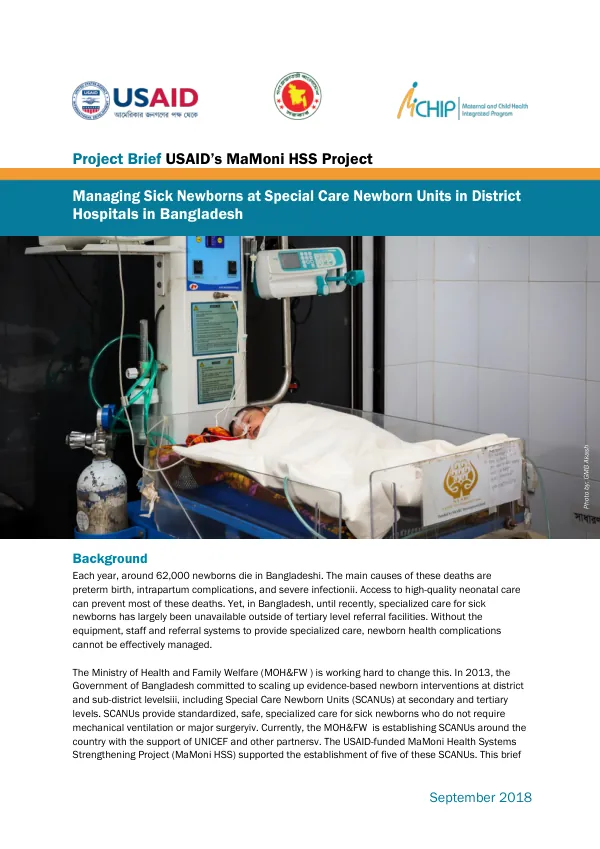
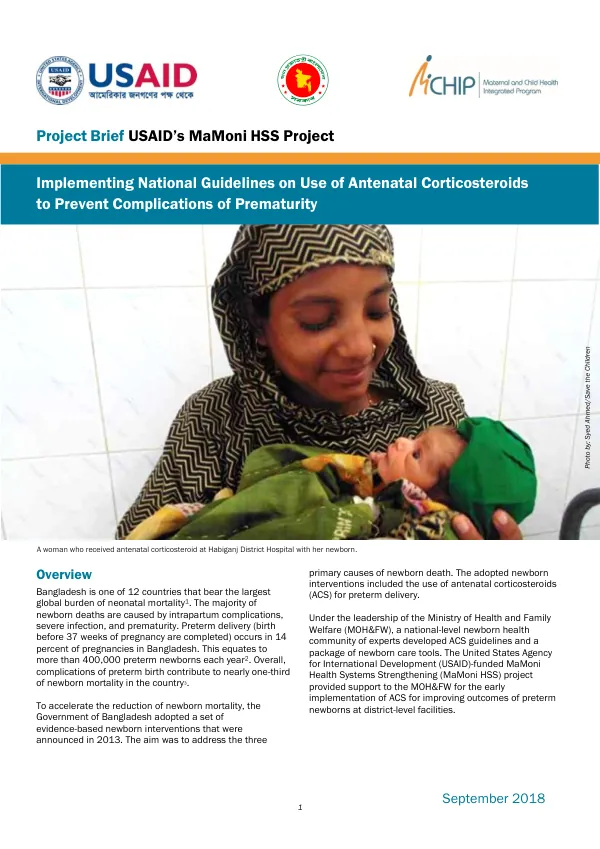
The project was led by the Ministry of Health and Family Welfare (MOH&FW) and received funding from the United States Agency for International Development (USAID). The primary goal of the project was to address the three primary causes of newborn death, including intrapartum complications, severe infection, and prematurity. Bangladesh is one of the 12 countries that bear the largest global burden of neonatal mortality. The majority of newborn deaths are caused by intrapartum complications, severe infection, and prematurity. Preterm delivery occurs in 14 percent of pregnancies in Bangladesh, resulting in more than 400,000 preterm newborns each year. Complications of preterm birth contribute to nearly one-third of newborn mortality in the country. To address this issue, the Government of Bangladesh adopted a set of evidence-based newborn interventions in 2013. The interventions included the use of antenatal corticosteroids (ACS) for preterm delivery. The MaMoni HSS project provided support to the MOH&FW for the early implementation of ACS for improving outcomes of preterm newborns at district-level facilities. The national guidelines on the use of ACS in threatened preterm deliveries to reduce neonatal mortality and morbidities were released in 2015. The guidelines follow the World Health Organization (WHO) recommendations on the necessary preconditions for safe and efficacious use of ACS. The recommended ACS dosage is dexamethasone 6 mg every 12 hours for a maximum of four doses or dexamethasone 12 mg every 24 hours for a maximum of two doses. The MaMoni HSS project supported the setup of special care newborn units (SCANUs) and kangaroo mother care units at three district hospitals. The project also mobilized technical experts to train providers in accordance with the national ACS guidelines and the Comprehensive Newborn Care Package (CNCP). The training focused on appropriate screening of cases and use of a decision algorithm to accurately determine gestational age and assess the signs of imminent birth. A review of the ACS intervention was conducted in mid-2017 and early 2018 to reflect upon its implementation experience in Habiganj and Noakhali district hospitals. The facility readiness assessment revealed that both hospitals had functional SCANUs and dedicated spaces for kangaroo mother care. The available SCANU equipment included radiant warmers, a phototherapy machine, and essentials for newborn resuscitation and safe oxygen use. From January 2016 to December 2017, 633 pregnant women received ACS at Habiganj and Noakhali district hospitals. Among them, 73 percent were between 24 and 34 weeks of gestation. The largest grouping of ACS recipients who fell outside this window were between 35 and 37 weeks of gestation. Overall, 425 (67%) were between 24 and 34 weeks of gestation and presented with a sign of imminent birth.