MANAGEMENT SCIENCES FOR HEALTH
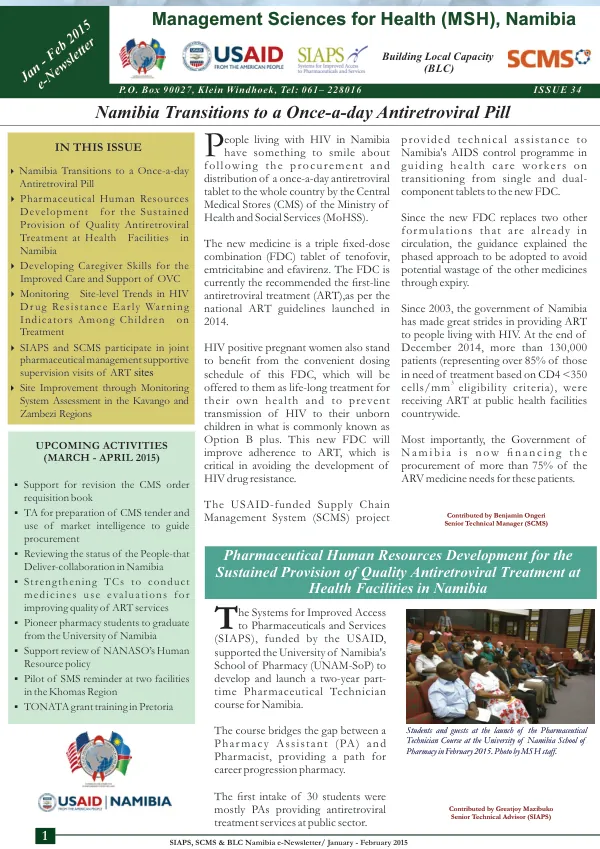
SIAPS, SCMS, BLC e-Newsletter: Building Local Capacity
In Namibia, the Ministry of Health and Social Services has been working to create awareness on antimicrobial resistance (AMR) and rational medicine use (RMU).
2015 · 6 pages
Sign in to readA free account is required to download.
Abstract
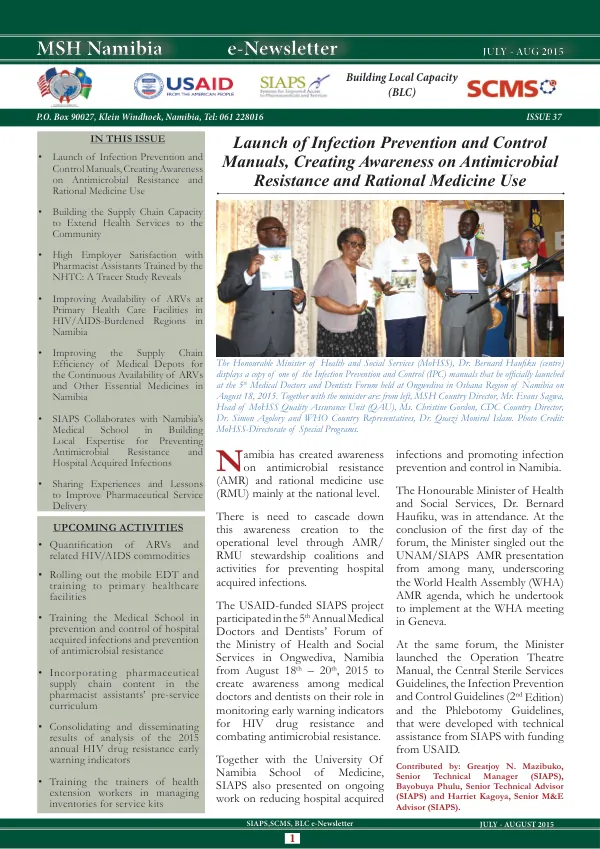
The USAID-funded SIAPS project participated in the 5th Annual Medical Doctors and Dentists' Forum to create awareness among medical doctors and dentists on their role in monitoring early warning indicators for HIV drug resistance and combating antimicrobial resistance. The Honourable Minister of Health and Social Services, Dr. Bernard Haufiku, launched the Operation Theatre Manual, the Central Sterile Services Guidelines, the Infection Prevention and Control Guidelines (2nd Edition), and the Phlebotomy Guidelines, which were developed with technical assistance from SIAPS with funding from USAID. The Supply Chain Management System (SCMS) project has been collaborating with the Namibian Ministry of Health and Social Services to build the supply chain capacity needed to support the extension of primary care health services to the community. SCMS provided technical assistance to the Directorate of Primary Health Care to develop standard operating procedures (SOPs) for managing health extension workers (HEW) kit supplies. The SOPs simplify the tasks required for the logistics management of HEW kit supplies to ensure an uninterrupted supply of products for the provision of health extension services. The National Health Training Center (NHTC) conducted a tracer study to inform strategies for improving the pharmacist assistant training program. The study collected qualitative and quantitative data from 91 respondents, including 57 pharmacist assistants, 26 employers/supervisors, and 8 other stakeholders. The key findings included high employer satisfaction with pharmacist assistants' performance, with 96% of employers and supervisors reporting satisfaction. The study also found that over 90% of surveyed pharmacist assistants have ever worked in ART clinics, and currently, 58% of pharmacist assistants serve in ART clinics, contributing to the scale-up and provision of essential ART services in Namibia. The uninterrupted availability of HIV/AIDS commodities at the antiretroviral therapy (ART) sites is critical to the success of Namibia's strategy of decentralizing ART services through the Nurse Initiated and Managed ART (NIMART) services. The public health commodity supply chain in Namibia has been strengthened through the implementation of the Logistics Management Information System (LMIS) and the introduction of the Electronic Data Transfer (EDT) system. The EDT system has improved the accuracy and timeliness of data on HIV/AIDS commodities, enabling the Ministry of Health and Social Services to make informed decisions on commodity management.