MANAGEMENT SCIENCES FOR HEALTH
SIAPS, SCMS & BLC Namibia e-Newsletter/ January - February 2015
The Namibian government has made significant strides in providing antiretroviral treatment (ART) to people living with HIV since 2003.
2015 · 4 pages
Sign in to readA free account is required to download.
Abstract
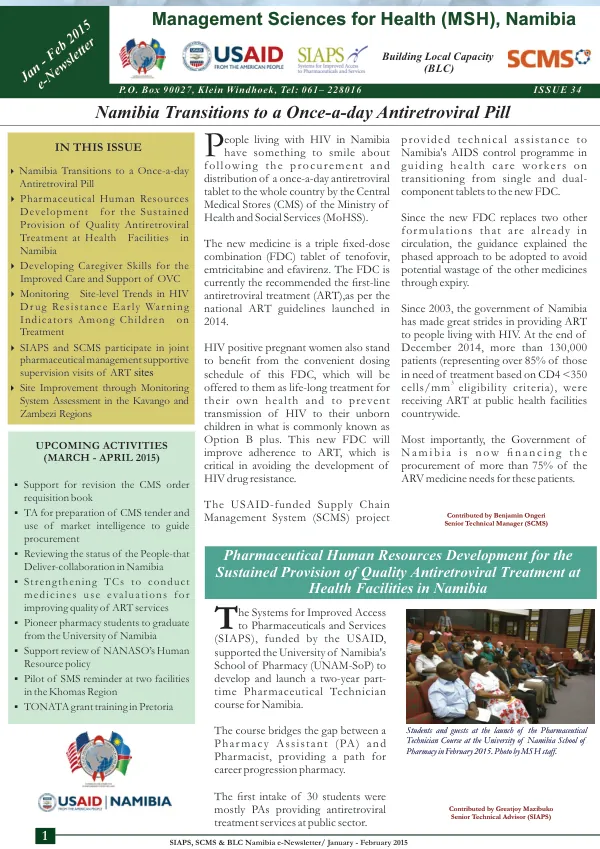
At the end of December 2014, more than 130,000 patients, representing over 85% of those in need of treatment based on CD4 <350 cells/mm eligibility criteria, were receiving ART at public health facilities countrywide. The government is now financing the procurement of more than 75% of the ARV medicine needs for these patients. The Central Medical Stores (CMS) of the Ministry of Health and Social Services (MoHSS) has procured and distributed a once-a-day antiretroviral tablet to the whole country. The new medicine is a triple fixed-dose combination (FDC) tablet of tenofovir, emtricitabine, and efavirenz, which is currently the recommended first-line ART, as per the national ART guidelines launched in 2014. HIV-positive pregnant women also stand to benefit from the convenient dosing schedule of this FDC, which will be offered to them as life-long treatment for their own health and to prevent transmission of HIV to their unborn children in what is commonly known as Option B plus. The USAID-funded Supply Chain Management System (SCMS) project provided technical assistance to Namibia's AIDS control programme in guiding healthcare workers on transitioning from single and dual-component tablets to the new FDC. Since the new FDC replaces two other formulations that are already in circulation, the guidance explained the phased approach to be adopted to avoid potential wastage of the other medicines through expiry. The Systems for Improved Access to Pharmaceuticals and Services (SIAPS) project, funded by the USAID, supported the University of Namibia's School of Pharmacy (UNAM-SoP) to develop and launch a two-year part-time Pharmaceutical Technician course for Namibia. The course bridges the gap between a Pharmacy Assistant (PA) and Pharmacist, providing a path for career progression in pharmacy. The first intake of 30 students were mostly PAs providing antiretroviral treatment services at public sector. The USAID-funded Building Local Capacity (BLC) project supports Church Alliance for Orphans (CAFO) in developing the skills of caregivers at Early Childhood Development (ECD) centers in measuring the upper arm circumference (MUAC) of children, psychosocial support (PSS), and critical care. The caregivers learn how to measure the circumference of the left upper arm, at the mid-point between the tip of the shoulder and the tip of the elbow. In children, MUAC is useful for the assessment of nutritional status and identification of malnutrition. The advantage of the MUAC is that it requires little equipment and is easy to perform. The BLC project has facilitated training for 254 female and 84 male caregivers between March and December 2014. This support further enabled CAFO to mobilize resources and work with the local communities to sustain the good practices at the centers. The USAID-funded BLC project in partnership with the CAFO, has been implementing the U.S. President's Emergency Plan for AIDS Relief (PEPFAR) Orphans and Vulnerable Children's (OVC) grant since March 2014. The SIAPS and SCMS projects joined the Division of Pharmaceutical Services at the Namibian Ministry of Health and Social Services (MoHSS) to conduct the 2015 edition of the annual pharmaceutical management supportive supervision visits (SSVs). These visits are aimed at improving the delivery of pharmaceutical services at all health facilities in the Namibian public sector. The 2015 SSVs mainly focused on reviewing the progress made by sites in implementing service improvement actions plans of 2014. SIAPS and SCMS technical advisors joined their MoHSS counterparts to assist with conducting the visits to 62 facilities, including 39 of 45 main ART sites countrywide. The USAID-funded SIAPS program has supported the Ministry of Health and Social Services (MoHSS) in Namibia to integrate the World Health Organization (WHO) recommended HIV-DR Early Warning Indicators (EWIs) into routine antiretroviral treatment (ART) programme reporting. Using data from the SIAPS-supported electronic dispensing tool (EDT), all Namibia's 50 ART sites are involved in quarterly and annual monitoring and review of HIV-DR EWIs. These site-level EWIs are monitored for both adults and children and include: on-time pill pick-up; ARV stock out rates, and ART patient retention in care. HIV-DR EWI site-level monitoring has been implemented since 2010.
Related documents