THE RESEARCH TRIANGLE INTERNATIONAL INSTITUTE
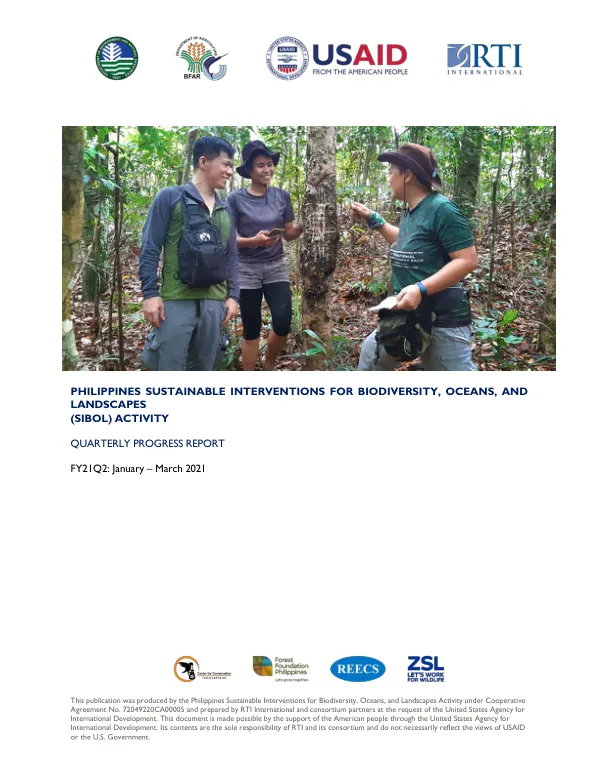
SIBOL QUARTERLY REPORT FY21Q3: APR – JUN 2021
The SIBOL Activity works at both the national and site levels, in partnership with the Department of Environment and Natural Resources (DENR), the Department of Agriculture's Bureau of Fisheries and Aquatic Resources (BFAR), Palawan Council for Sustainable Development (PCSD), and USAID.
2021 · 39 pages
Sign in to readA free account is required to download.
Abstract
All interventions under SIBOL follow the Planetary Health approach, which examines the links between the environment and human health and well-being. The approach uses cutting-edge science, coordinated and inclusive governance strategies, and powerful economic incentives to protect both biodiversity and the communities in and around targeted terrestrial and marine landscapes. The SIBOL Activity aims to increase the effectiveness of natural resource and protected area (PA) management and demonstrate positive environmental behavior through development of social capital. The project's interventions will also help with the sustainable management of the natural resources sector, improved governance of natural resources, and reduced environmental crime and unsustainable environmental practices. Following USAID's Theory of Change (ToC), SIBOL developed a results chain through a collaborative process involving USAID and the Philippine government during co-development and start-up workshops. The results chain was further refined after a series of discussions with USAID and other stakeholders. The Activity's results chain contains three main strategic approaches: Strategic Approach 1: Strengthening science-driven decision making, Strategic Approach 2: Improving economic incentives, and Strategic Approach 3: Strengthening enforcement. SIBOL has started to work at the national level, with the coordination, support, and partnership of DENR, BFAR, and USAID. The Activity has finalized its four sites: Masinloc and Oyon Bay in Zambales, Siargao Island in Surigao del Norte, and Palawan. The SIBOL Activity works closely with the Department of Agriculture's Bureau of Fisheries and Aquatic Resources, the Center for Conservation Innovations, Forest Foundation Philippines, Zoological Society of London, and the Resources, Environment and Economics Center for Studies. The project aims to reduce greenhouse gas emissions through sustainable landscapes activities, increase economic growth, and improve governance of natural resources. The Activity's results chain will be refined after incorporating the latest comments received from USAID. SIBOL has started to work at the national level, with the coordination, support, and partnership of DENR, BFAR, and USAID. The Activity has finalized its four sites: Masinloc and Oyon Bay in Zambales, Siargao Island in Surigao del Norte, and Palawan. The SIBOL Activity works closely with the Department of Agriculture's Bureau of Fisheries and Aquatic Resources, the Center for Conservation Innovations, Forest Foundation Philippines, Zoological Society of London, and the Resources, Environment and Economics Center for Studies. The project aims to reduce greenhouse gas emissions through sustainable landscapes activities, increase economic growth, and improve governance of natural resources. The Activity's results chain will be refined after incorporating the latest comments received from USAID. SIBOL is in the process of recalibrating and revising several of its MEL plan targets and indicators to account for implementation delays brought about by the coronavirus disease 19 (COVID-19) pandemic. The Activity will also incorporate the latest comments received from USAID in its finalization of the MEL plan. The most recent adjustments to SIBOL performance indicators in the MEL plan include the revision of targets for economic growth (EG) 13.6: Greenhouse gas emissions, estimated in metric tons of CO2 equivalent, reduced, sequestered, or avoided through sustainable landscapes activities supported by United States Government (USG) assistance. The life of activity (LOA) target of 1.0 million metric tons has been revised.
![Evaluation of the US-Asia environmental partnership [US-AEP]](https://covers.devme.ai/gen/5422.webp)
![Evaluation of the US-Asia environmental partnership [US-AEP]](https://covers.devme.ai/gen/44258.webp)