USAID
Side by Side Comparison of Foreign Aid Reform Bills
The United States government has introduced two foreign assistance reform bills in the House and Senate.
2009 · 3 pages
Sign in to readA free account is required to download.
Abstract
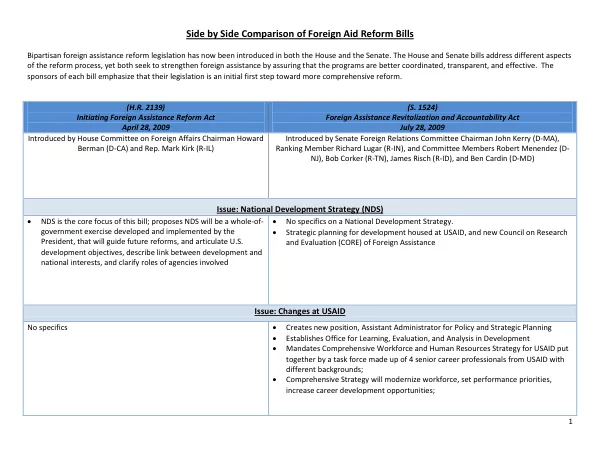
The bills, H.R. 2139 and S. 1524, aim to improve the effectiveness and transparency of foreign assistance programs. The sponsors of the bills emphasize that they are initial steps toward comprehensive reform. The bills focus on several key issues, including the development of a National Development Strategy (NDS). The NDS will be a whole-of-government approach that articulates U.S. development objectives and clarifies the roles of agencies involved. The strategy will be developed and implemented by the President and will guide future reforms. The bills also propose changes at the U.S. Agency for International Development (USAID). A new position, Assistant Administrator for Policy and Strategic Planning, will be created, and a new Office for Learning, Evaluation, and Analysis in Development will be established within the Bureau for Policy and Strategic Planning. The office will be responsible for monitoring and evaluating projects, collecting lessons learned, and serving as a government resource on project evaluation. The bills also address changes in the way U.S. development efforts are carried out. The USAID Chief of Mission will be responsible for overseeing all U.S. development efforts in a country, and a comprehensive examination of mission structure will be conducted. The Administrator will report to Congress after 18 months on modernization efforts, including balancing roles and improving coordination with other agencies. The bills also emphasize the importance of transparency and accountability in foreign assistance programs. Information on foreign assistance programs will be made publicly accessible, and the President will fully engage in the International Aid Transparency Initiative established at the Accra High Level Forum on Aid Effectiveness. In terms of authorization, the bills authorize $5 million for the USAID Office for Learning, Evaluation, and Analysis in Development for FY11 and $30 million for the same office for FY11, with an additional $5 million each year until FY15.