AECOM INTERNATIONAL
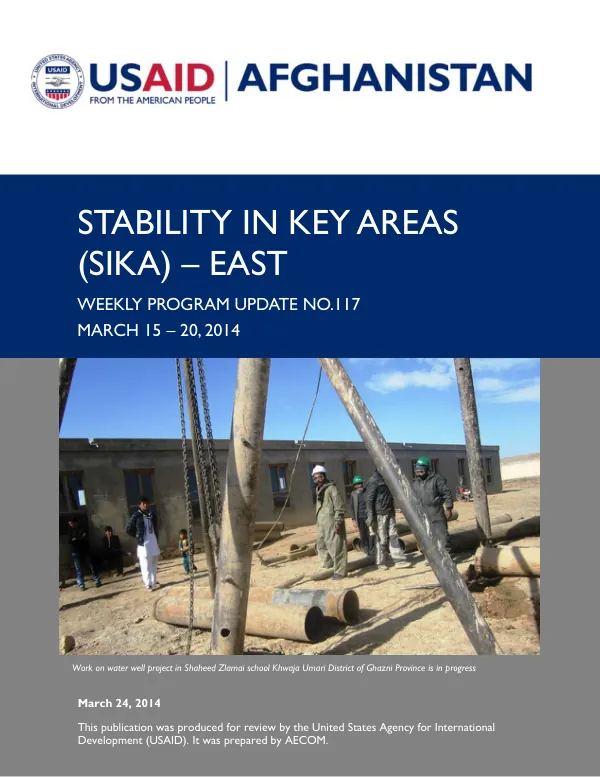
SIKA-East Weekly Program Update: March 15- 20, 2014
Stability in Key Areas (SIKA) – East is a program aimed at promoting stability and development in the eastern regions of Afghanistan.
2014 · 7 pages
Sign in to readA free account is required to download.
Abstract
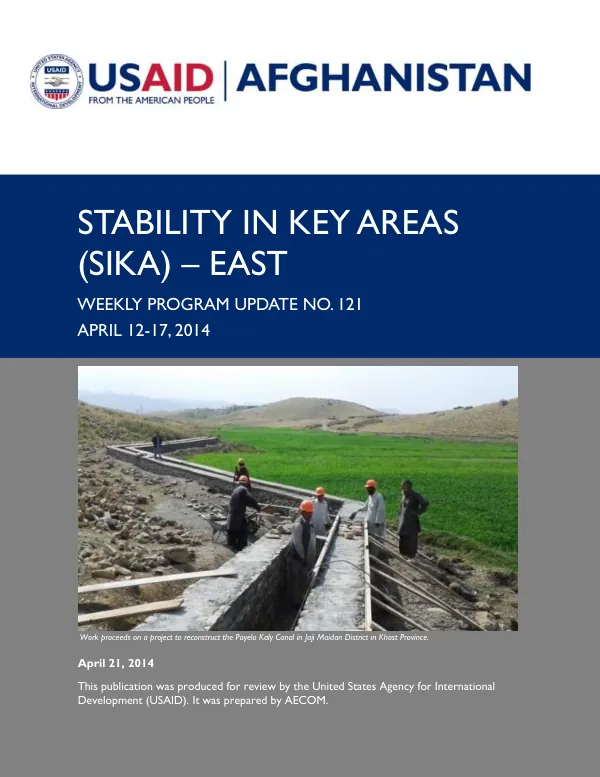
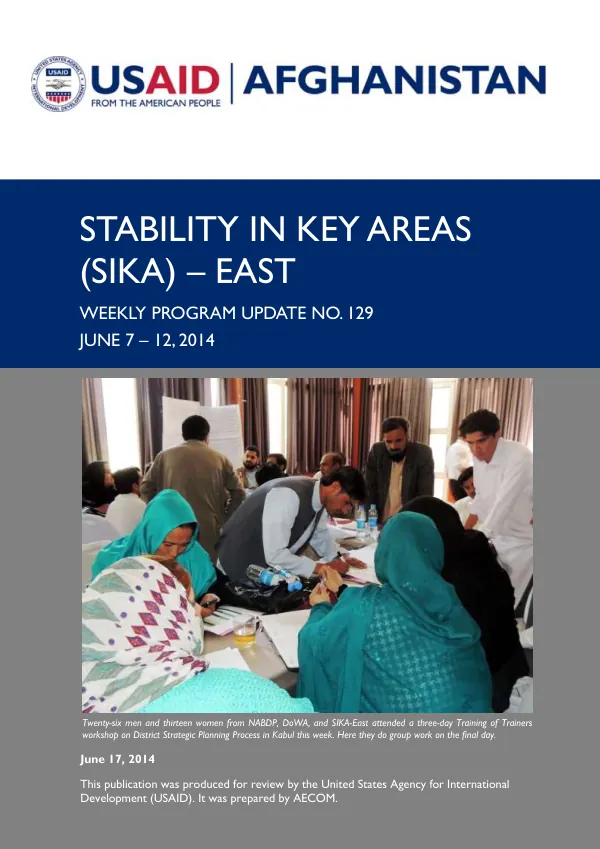
The program is implemented by AECOM, with funding from the United States Agency for International Development (USAID). The program's primary focus is on supporting the District Development Assembly (DDA) process, which is a key component of the Afghan government's decentralization efforts. The SIKA-East program has made significant progress in the past week, with several key activities taking place across the region. In Baraki Barak District of Logar Province, two projects were completed: the Tagab Payan school boundary wall and the Naw Abad Zargaran karez rehabilitation project. The total cost of these projects was over $81,000, and they were started on September 5 and October 29, 2013, respectively. Additionally, implementation of two infrastructure projects began during the week: the Shayan Karez rehabilitation project in Baraki Barak and the Sangar Khel protection wall construction project in Mohammad Agha District. Training activities were also conducted in nine districts across the region, with a total of 148 men and five women participating in sessions on Grants Management, Infrastructure Project Implementation, Negotiation Strategy, and Fundraising. The training sessions were conducted in districts such as Khwaja Umari, Gurbuz, Mando Zayi, Tani, Baraki Barak, Khoshi, Jalrez, and Zadran. The SIKA-East program has also made significant progress in terms of grant awards, with 11 grants worth over $373,000 being awarded in seven districts. To date, 417 grant applications have been received, and 282 applications have been approved by USAID. Three grant applications, valued at nearly $864,000, were reviewed and approved by joint MRRD and SIKA-East Grant Review Committees (GRC). The approved projects are slated for two districts. In terms of gender activities, the SIKA-East program has made significant progress in promoting women's participation in the DDA process. A briefing paper was drafted on female perspectives on district planning, which will cover the cooperation between male and female DDA+ members, prioritization of problems and solutions, and how local resiliencies and advocacy efforts have helped address these concerns. The paper will offer recommendations on how female perspectives can be further integrated in district planning and what steps can be taken to encourage dialogue between male and female DDA+ members throughout the entire process. The SIKA-East program has also made significant progress in terms of infrastructure development, with seven new engineering designs being completed in the reporting period. These designs cover projects in seven districts and are valued at nearly $258,000. Additionally, three grant applications, valued at nearly $864,000, were reviewed and approved by joint MRRD and SIKA-East Grant Review Committees (GRC). The approved projects are slated for two districts. Overall, the SIKA-East program has made significant progress in promoting stability and development in the eastern regions of Afghanistan. The program's focus on supporting the DDA process, promoting women's participation, and infrastructure development has been instrumental in achieving this progress.
Related documents