AECOM INTERNATIONAL
Stability in Key Areas (SIKA) – East Weekly Program Update: June 14 – 19, 2014
Stability in Key Areas (SIKA) – East was launched in Paktika Province on June 18, 2014, marking the sixth province in southeastern Afghanistan to implement the program.
2014 · 7 pages
Sign in to readA free account is required to download.
Abstract
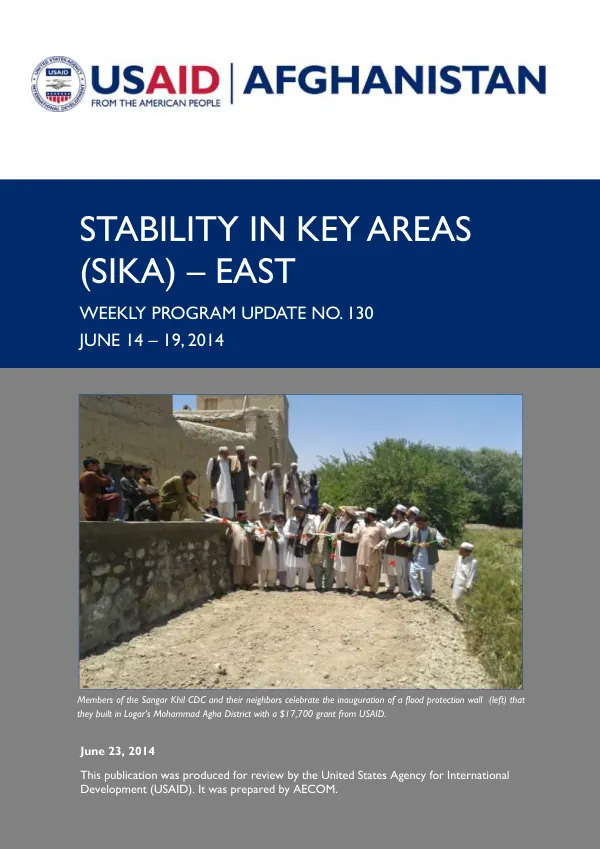
The launch meeting was attended by 170 men and 17 women, including top government officials, members of District Development Assemblies (DDA+) and Community Development Councils (CDC), religious scholars, tribal elders, and ordinary citizens. The PRRD Director for Paktika welcomed everyone to the launch meeting and explained the goals and importance of the SIKA-East program. SIKA-East's manager for Paktika described the program and its implementation strategy in more detail. The SIKA-East program aims to enhance stability in key areas through various activities, including training, grants, and infrastructure development. During the week, nine training sessions were held for 150 men and 95 women in seven districts, focusing on Stakeholder Orientation, District Strategic Planning Process, Infrastructure Project Implementation, and Grants Management. The training sessions were part of the program's capacity-building efforts to empower local communities and improve their ability to manage and implement development projects. Grants and infrastructure development are also key components of the SIKA-East program. One grant award, worth over $31,000, was made this week for a project in Ahmad Abad District of Paktya Province. Six small infrastructure projects were completed successfully in three provinces: three in Logar, two in Paktya, and one in Maydan Wardak. Twenty-seven milestone payments, valued at over $297,000, were made to projects in seventeen districts. Fourteen grant applications, worth more than $397,000, were reviewed and approved by joint MRRD and SIKA-East Grant Review Committees. The program also focuses on empowering women through various initiatives. Five female DDA+ leaders from each original province, along with the five SIKA-East gender officers, visited Kabul to learn from economic activities established for women who have little or no mobility. The women also met with representatives of the Ministry of Rural Rehabilitation and Development's (MRRD) Afghanistan Rural Enterprise Development Program (AREDP), which orients women leaders towards economic empowerment. The main finding of the two-day site visit was that female DDA+ leaders were keen on developing advocacy initiatives via communication committee meetings in their provinces. In addition to these activities, SIKA-East prepared six district profiles for the new targeted districts: Ali Khail, Mirzaka, and Sayed Karam (Paktya); Maydan Shahr (Maydan Wardak); Muqur (Ghazni); and Nadir Shah Kot (Khost). The district profiles are ready to be shared with USAID. SIKA-East also drafted a concept note for resource coordination meetings as transition initiatives, outlining a clear vision of the roles and responsibilities of DDA+ members. The concept note is expected to be reviewed and finalized next week. Overall, the SIKA-East program aims to enhance stability in key areas through various activities, including training, grants, infrastructure development, and empowerment of women. The program has made significant progress in its implementation, with various activities and initiatives underway in different districts and provinces.
Related documents