AECOM INTERNATIONAL
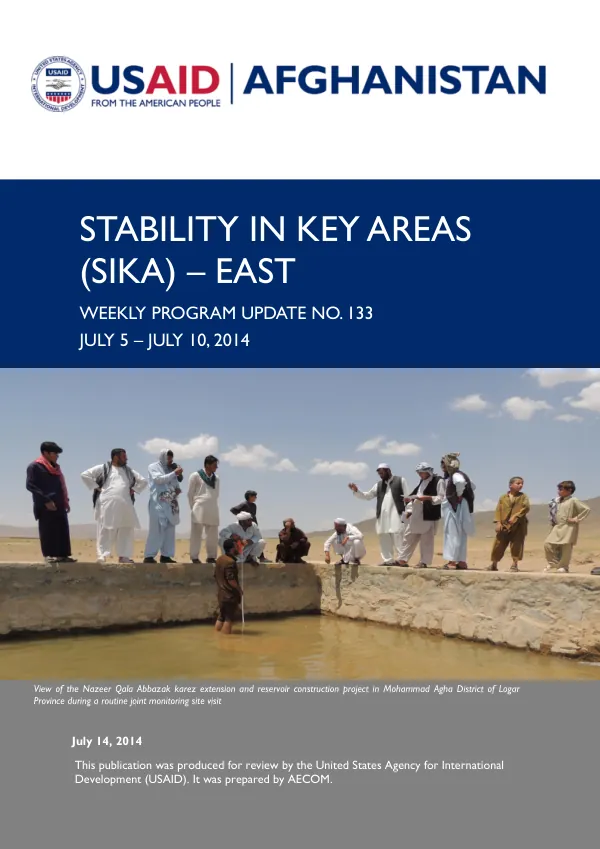
Stability in Key Areas (SIKA) – East Weekly Program Update: July 5 – July 10, 2014
Stability in Key Areas (SIKA) – East is a program aimed at promoting stability and development in the eastern provinces of Afghanistan.
2014 · 7 pages
Sign in to readA free account is required to download.
Abstract
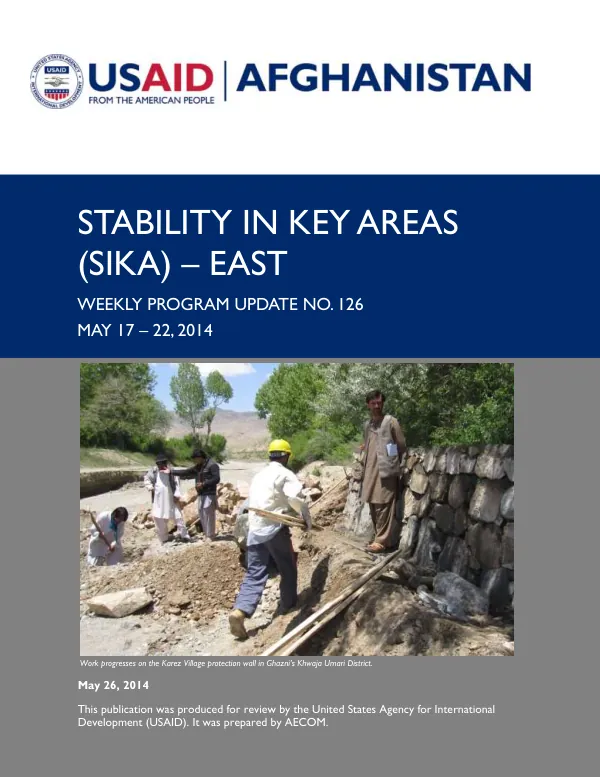
The program is implemented by SIKA-East, in partnership with the Ministry of Rural Rehabilitation and Development (MRRD) and the United States Agency for International Development (USAID). The program's primary focus is on supporting the development of infrastructure, governance, and economic empowerment in the target districts. Training and capacity building are key components of the SIKA-East program. During the week of July 5-10, 2014, 12 training sessions were held for 123 men and 155 women from nine districts. The training sessions covered topics such as District Strategic Planning Process (DSPP), Governance Foundation, Grants Management, Infrastructure Project Planning, Operations and Maintenance, and Stakeholder Orientation. The training sessions were designed to enhance the capacity of local leaders and stakeholders to plan, implement, and monitor development projects. Infrastructure development is another critical aspect of the SIKA-East program. During the week of July 5-10, 2014, three small infrastructure projects were completed in two provinces, with a total value of over $59,000. The projects included the Mila ditch construction project in Laja Mangal, Paktya Province, and the Tormay and Godul Qandary and Karez protection wall projects in Khwaja Umari District of Ghazni Province. Additionally, six grant awards were made for projects in Mohammad Agha, Laja Mangal, Mando Zayi, and Baraki Barak Districts, valued at over $226,000. The SIKA-East program also places a strong emphasis on environmental protection and conservation of natural resources. The Environmental Protection Scope of Work (SoW) initial draft was developed this week by SIKA-East and MRRD. The objective of the SoW is to raise awareness of local communities, Community Development Councils (CDC), DDAs+, District Community Council (DCC) and other local government entities about environmental protection and conservation of natural resources. The program's progress is monitored through regular site visits and joint monitoring site visits with program stakeholders. During the week of July 5-10, 2014, 10 joint site visits were facilitated with program stakeholders in eight districts. The site visits were designed to transfer ownership of monitoring and evaluation tasks to provincial and district authorities. The SIKA-East program has made significant progress in the eastern provinces of Afghanistan. To date, 259 projects with a total value of over $9.2 million have been awarded to 22 districts, including Garda Serai Sub-district of Zadran District in Paktya. The program has also received 503 grant applications, valued at over $20.2 million, and has approved 382 applications. The cumulative value of completed grant projects is over $4 million. In Ghazni Province, two small infrastructure projects were completed, valued at over $37,000, which will benefit 2,890 individuals. Two milestone payments worth more than $3,000 were made for Khwaja Umari District. Two engineering designs worth over $175,000 were completed and finalized for Khwaja Umari and Dih Yak Districts. A Joint PRRD and SIKA-East GRC reviewed and approved four projects, cumulatively valued at over $175,000. In Khost Province, two separate Operation and Maintenance training sessions were conducted for 32 men from Mando Zayi and Tani Districts. One engineering design, valued at over $94,000, was completed for Mando Zayi District. A Joint PRRD and SIKA-East GRC reviewed and approved three projects worth over $159,000. One grant worth nearly $73,000 was awarded for Mando Zayi District. In Logar Province, a Grants Management training session was held on July 6 for 16 men from Mohammad Agha District. Two milestone payments worth more than $20,000 were made for Khoshi and Mohammad Agha District. Two awards valued at nearly $48,000 were made for Mohammad Agha and Baraki Barak Districts. In Maydan Wardak Province, an Operation and Maintenance training session was conducted for 14 men from Tani District.
Related documents