USAID. MISSION TO BURKINA FASO
Small economic activity development
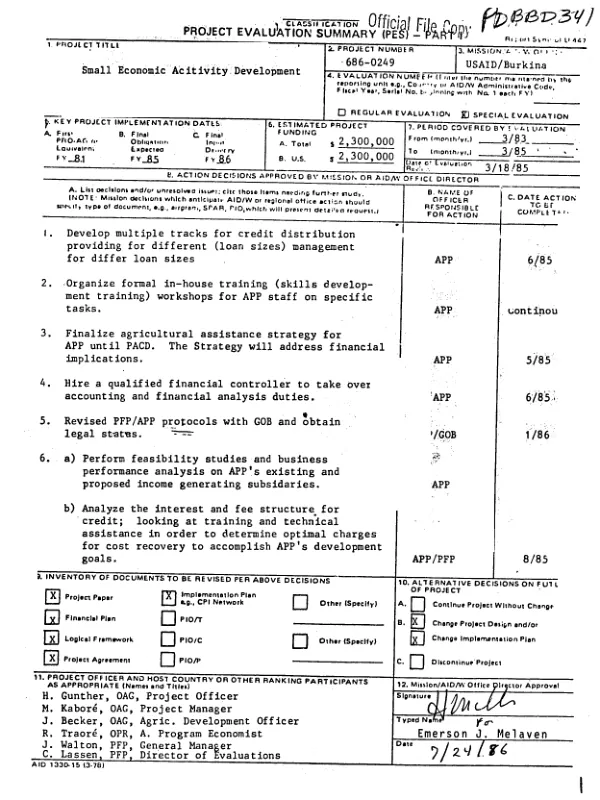
Evaluates OPG to Partnership for Productivity (PfP) to promote small enterprise (SE) development in Burkina Faso"s Eastern Department, mainly by establishing an indigenous private development organization (herein referred to, without specification, as APP).
Gunther, Helen; Kabore, M. · 1986
Sign in to readA free account is required to download.
Abstract
Mid-term PES covers the period 3/83-3/85 and is based on a survey of APP clients and non-APP entrepreneurs. APP has far surpassed expectations despite difficult regional conditions. It has made some 350 SE loans annually, against a target of 250, and established field offices in 4 regions and 1 sub region, against a target of 3 regions. A fully indigenous form of the APP (which is currently run partly by expatriates) is being formed; lawyers are drawing up the necessary papers and staff are receiving on-the-job training. APP"s ability to fund 10% of costs through locally generated income makes it appear that its projected self-sufficiency may come through its own income-generating enterprises. The major unplanned event has been a 3-year drought which has been detrimental to development in the region. In addition, a change in host government administration and its lack of a clearly defined policy on SE development has made the future of private sector activities in Burkina Faso uncertain. Three lessons were learned. (1) APP must approach the question of project subsidiaries like any other rational firm, by doing feasibility studies on subsidiaries" potential income-generating activities. (2) APP must make sure that local cadre are capable of taking over the organization after the expatriates leave. (3) Since it is always a good idea to have more than one funding source, PfP/APP should consider other donors beside USAID/BF for future funding. The PfP model has much to offer other development organizations interested in promoting the African private sector.