USAID DEC
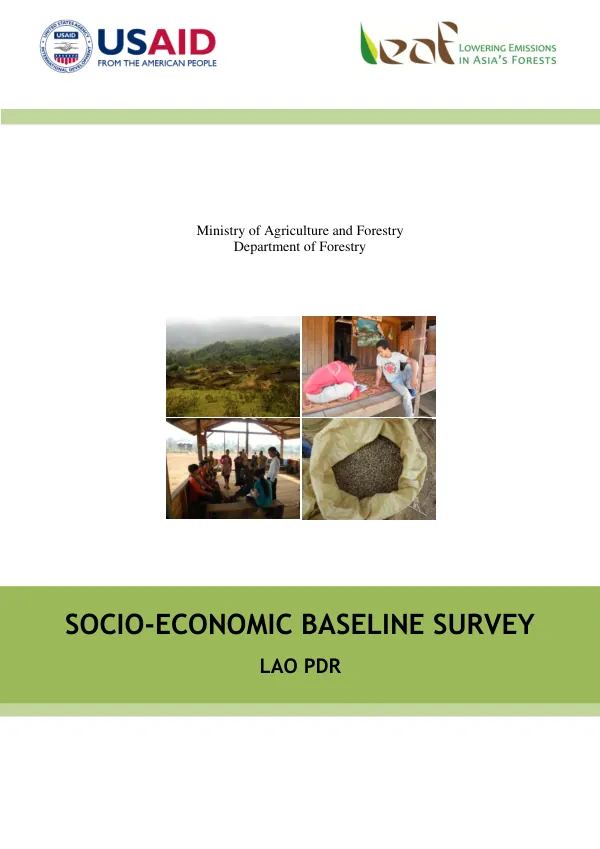
Socio-Economic Baseline Survey for Lowering Emissions in Asia's Forests (LEAF) Program in Lao PDR
Sign inMACEDONIAN MINISTRY OF AGRICULTURE, FORESTRY AND WATER ECONOMY
Socio-Economic Baseline Survey for Lowering Emissions in Asia's Forests (LEAF) Program in Lao PDR
The Lowering Emissions in Asia's Forests (LEAF) Program is a five-year cooperative agreement funded by the United States Agency for International Development's (USAID) Regional Development Mission for Asia (RDMA).
2013 · 93 pages
Sign in to readA free account is required to download.
Abstract
The program is being implemented by Winrock International (Winrock), in partnership with SNV – Netherlands Development Organization, Climate Focus, and The Center for People and Forests (RECOFTC). The LEAF program began in 2011 and will continue until 2016. The program aims to reduce greenhouse gas emissions from deforestation and forest degradation in the Lao People's Democratic Republic (PDR). To achieve this goal, the program focuses on improving forest management practices, promoting sustainable land-use planning, and enhancing the livelihoods of local communities. The program targets three districts in the Lao PDR: Attapeu Province, Huaphanh Province, and Viengxay District. A socio-economic baseline survey was conducted to gather data on the current situation of the target communities. The survey collected information on household characteristics, expenditure, housing, land ownership, farming practices, livestock, and forest products use. The survey also included focus group discussions to gather information on gendered roles and responsibilities, drivers of deforestation and forest degradation, and livelihoods. The survey found that the majority of households in the target communities are engaged in agriculture, with most households owning less than 1 hectare of land. The average annual expenditure per household on selected main categories is approximately $1,300. The survey also found that the majority of households rely on forest products and aquatic resources for income, with an average annual income of $200 per household. The survey identified several challenges and opportunities for improving the livelihoods of local communities. The main challenges include deforestation and forest degradation, limited access to markets, and lack of skills and knowledge. The main opportunities include the potential for expanding household income through the introduction of new farming and enterprise activities, as well as the potential for improving forest management practices. The LEAF program will use the data collected from the socio-economic baseline survey to inform its interventions and monitor its progress. The program will focus on improving forest management practices, promoting sustainable land-use planning, and enhancing the livelihoods of local communities. The program will also establish a monitoring system to track its progress and make adjustments as needed. The program's monitoring indicators include deforestation rates, forest cover, and greenhouse gas emissions. The program will also track the livelihoods of local communities, including their income, employment, and access to markets. The program's monitoring system will provide valuable information for evaluating its effectiveness and making adjustments to its interventions. The LEAF program has the potential to make a significant impact on reducing greenhouse gas emissions from deforestation and forest degradation in the Lao PDR. By improving forest management practices, promoting sustainable land-use planning, and enhancing the livelihoods of local communities, the program can help to reduce deforestation rates and promote sustainable forest management.